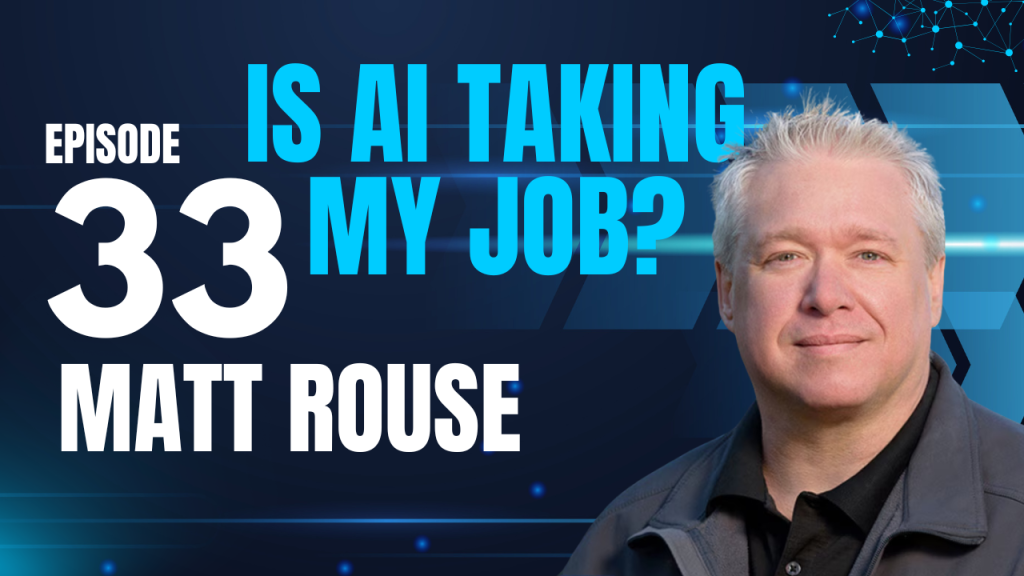

Artificial intelligence is rewriting the rules of business, and the wave of new AI tools, generative AI platforms, and future-of-work trends has pushed the “Will AI take my job?” question to the top of every entrepreneur’s mind. In this week’s episode of DissedMedia: A Startup Story, I sat down with tech veteran and author Matt Rouse to talk about how artificial intelligence is reshaping careers, what roles are actually at risk, and how small businesses can turn AI productivity and automation into a competitive edge.

From Dial-Up Days to Generative AI
Matt’s story starts long before algorithms and machine learning, back in the bulletin-board-system era, when computing required persistence, curiosity, and a whole lot of improvisation. That early hacker mentality eventually led him into electronics, early broadband tech support, SEO, web development, and later founding digital marketing agencies on both sides of the border.
That long career arc gives him a unique vantage point: he’s lived through multiple tech revolutions, but none as fast or as disruptive as today’s AI tools and generative AI models. And that’s exactly why his book Will AI Take My Job 2 feels timely.
So… Is AI Taking Your Job or Not?
Matt’s answer is the honest one: it depends.
If your day-to-day work involves:
- Sorting information
- Responding to routine requests
- Handling predictable workflows
- Making small, repetitive decisions
…AI is already very good at that. Customer support, data entry, entry-level analysis, and basic knowledge work are the easiest targets for artificial intelligence automation.
But the flip side is where the real opportunity lives.
AI also creates new roles:
- AI system operators
- Workflow designers
- Prompt engineers
- Creative strategists who can blend human judgment with AI tools
- Small business owners using AI productivity to scale faster
What disappears is not “jobs” but rather tasks. What grows is the need for people who can orchestrate generative AI platforms instead of competing with them.
The Speed Problem
Matt argues that the biggest reason people feel overwhelmed is because AI growth is hyper-exponential. Capabilities double roughly every seven months, meaning:
- If you tested AI 3 months ago, you’re already behind.
- If you tested it last year, you’re eight generations behind.
- If your competitors adopt AI before you, they will lap you.
This is why you hear “future of work” discussions everywhere. The pace is unforgiving, and falling behind is easy if you’re not paying attention to the right AI trends and tools.
AI Is Already Doing What Used to Take Weeks
One of the best real-world examples from our conversation was video production. What once required a full camera crew, editing team, and a $10,000 budget can now be done with generative AI for under $100.
With tools that can:
- Write scripts
- Generate voices
- Sync animations
- Produce footage
- Edit final cuts
…a small business can now create marketing assets in a single afternoon. This is AI productivity in its purest form, not replacing creativity, but removing barriers to producing it. Episode 33_ Matt Rouse Is AI Ta…
And this trend isn’t slowing down. By 2027, AI-generated video may be indistinguishable from live-shot production.
Creativity Isn’t Dying It’s Evolving
A recurring fear is that generative AI will kill originality. Matt’s take is refreshingly grounded: humans who collaborate with AI will create more, not less.
AI can:
- Draft ideas
- Remix styles
- Generate rough cuts
- Handle technical execution
Humans bring the taste, direction, and strategy. It’s the same evolution we saw in digital photography, music production, and social media creation. AI tools accelerate creativity.
The Coming Shockwave in Education
As instructors, we dug into how AI is transforming learning. Students who once struggled with writing now submit polished essays they can’t explain. Chatbots can generate APA citations, proofread papers, and even summarize textbooks.
Traditional grading systems weren’t designed for AI-assisted writing, and universities are scrambling to adapt. Matt predicts the next five years will bring:
- More certificate-based learning
- Less emphasis on grammar and more on critical thinking
- AI-enhanced coursework
- On-demand, personalized learning
- A shift toward real-world project skills
In other words, education is about to face the same disruption businesses are facing now, and only the flexible institutions will survive.
How Matt Is Using AI Inside His Own Business
Matt rebuilt his company because of AI.
He realized that if he didn’t adapt, parts of his agency would be obsolete within a few years. So he restructured, launched new services, and built their SMB Autopilot platform to solve problems AI tools still aren’t great at, especially in local marketing.
It’s the perfect example of embracing the future of work instead of fearing it.
The Real Question Isn’t “Will AI Take My Job?”
It’s “How do I use AI so I don’t get left behind?”
Matt’s biggest takeaway is simple but essential:
Stay informed, stay adaptable, and look for the blind spots before your competitors do.
AI is here. And the leaders who lean into generative AI, AI marketing, automation, and AI productivity tools will outperform those who cling to the old way of working.
Where to Find Matt Rouse
Matt’s book Will AI Take My Job 2 is available on Amazon.
More of his work lives at matthewrouse.com and on LinkedIn.