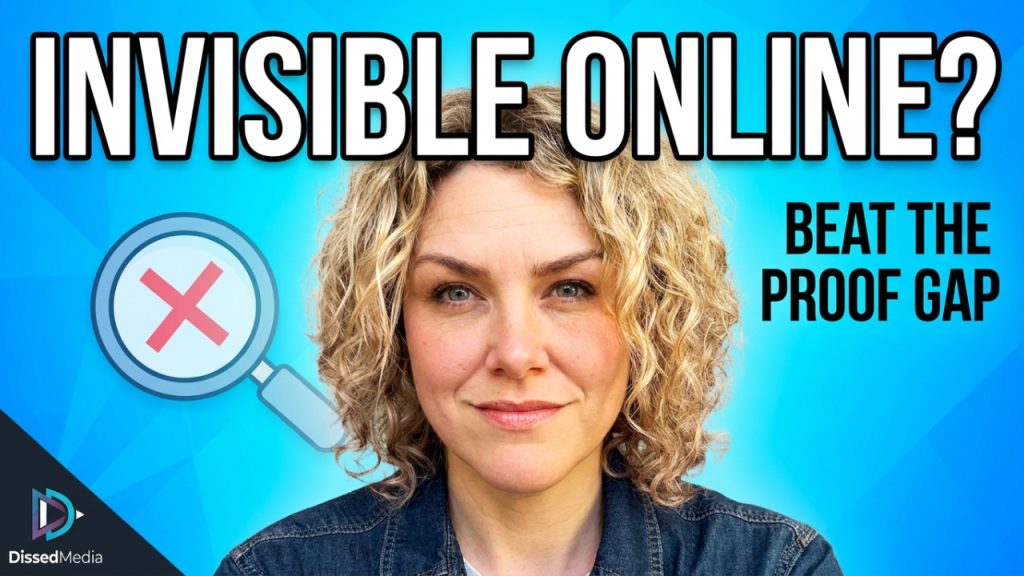

Some of the most knowledgeable people in any industry are nearly impossible to find online. They carry decades of experience, sharp judgment, and the kind of nuance that only comes from doing the work for years. When someone searches their name, though, very little comes back. On a recent episode of DissedMedia: A Startup Story, host Ben Olmos explored that problem with Ashley Smith, a former realtor of 18 years who now helps professionals close what she calls the proof gap.
The proof gap is the distance between what a person knows and what shows up when someone looks them up. For professionals who built their reputations on referrals and relationships, that distance rarely mattered. In the AI search era, it matters a great deal, and closing it has become one of the clearest ways to get found in AI search results and AI-generated answers.
The Proof Gap Explained
Smith spent nearly two decades inside a traditional, relationship-driven business. She sat on industry boards for 15 years and chaired an organization representing 14,000 professionals. Across that network, one pattern stood out. The people with the deepest expertise were frequently the least visible online. Trust and word of mouth carried their careers, so building a digital presence never felt urgent.
That approach held up until consumer behavior began to shift. When Smith started referring trusted colleagues to people in other cities, she noticed something uncomfortable. The professionals she respected most often had almost no searchable footprint, and the referral landed weaker because of it. The expertise was real. The proof was missing.

Why AI Search Changed the Rules
Search itself is being rebuilt. Google has signaled its largest change to search in 25 years, moving away from ten blue links toward AI overviews that summarize answers directly on the results page. More people now read that summary first and scroll less. Voice queries and conversational tools are pulling even more traffic into that answer layer.
Those systems are hunting for real authority signals. They reward original insight, lived experience, and a documented point of view, and they discount the flood of generic content that anyone can produce in minutes. This is where answer engine optimization enters the picture. Getting cited in an AI answer depends less on volume and more on whether a professional has published clear, credible, first-hand thinking that a model can attribute to a real person.
How Podcasting Earned a Google Index in Three Days
Smith carries one of the most common names in the English language, which made visibility a genuine challenge. The method that finally moved the needle was podcasting. After publishing conversations through an RSS feed, her thinking was indexed on Google within three days, and it outranked the material she posted on YouTube.
The mechanics explain why. When audio is distributed through an RSS feed, it flows to third-party platforms like Apple, Spotify, and Amazon, and that distribution adds trust even when the host is the person behind the show. Search engines also favor the way podcast data is structured, with a clear title, description, and increasingly an AI-generated transcript attached to every episode. SEO for podcasts rewards that structure, and podcasting for business gives experienced professionals a repeatable way to publish expertise in a format built for discovery.
Minimum Viable Proof
Smith frames the starting point around a concept she calls minimum viable proof, the smallest amount of credible evidence a professional needs to be taken seriously. The way to find it is to put on a consumer hat. Before hiring someone for anything that carries real cost or risk, most people look them up first. Minimum viable proof is whatever a searcher needs to see to feel confident enough to make contact.
The self-test is direct. Search your own name and profession, then judge the result honestly. If a summary from Google or an AI tool cannot surface a clear point of view, the proof gap is still open. That standard shifts by person, market, and moment, which is why revisiting it matters as consumer behavior keeps changing.
The 90 Day Sprint
Momentum comes from intention over a defined window. Smith often guides professionals through a 90 day sprint, publishing something relevant once a week for three months. The goal is not viral reach. It is a steady accumulation of layers around the topics a professional wants to be known for.
Timeliness carries weight in that process. A strong article from two years ago loses ranking power simply because it is dated. Refreshing it with current context and republishing with a new date can restore much of that value. After the initial sprint, the cadence can ease to biweekly or monthly, with the same self-check running in the background: search yourself and confirm the presence still reflects the work.

Getting Platformed by Others
The strongest signal comes from outside sources. Being referenced or cited by someone else, especially as a trusted authority, tends to carry far more weight than self-published content alone. Guesting on podcasts, contributing quotes to publications, and linking those mentions back to a single home base all reinforce that a scattered set of results belongs to one credible person.
This is also where the opportunity opens for younger and emerging professionals. The invisibility of senior experts creates space for the next generation to pair up, handle the technical setup, and help established leaders build the presence their reputations deserve. Both sides gain from the exchange.
Standing Out in a Crowded Niche
Business content is a crowded field, and that reality stops many capable people before they start. Olmos pushed back on that hesitation during the conversation. DissedMedia plays in the same crowded space, yet it narrows in on a specific mission and audience rather than chasing scale for its own sake.
The takeaway is to compete on focus. There is no need to outrank a national publication or a major creator. Owning a clear corner, serving a defined audience, and publishing a distinct point of view is enough to float to the top for the right searchers. A slightly different angle that no one else has documented can become the exact thing an AI engine surfaces later.
Where to Start
The hardest part is the first step. Perfection is the wrong target, and waiting for it keeps expertise invisible. The practical move is to record honest conversations, publish them where they can be indexed, and connect every profile so search engines and AI tools recognize a single, consistent identity. From there, presence compounds.
For professionals sitting on decades of hard-won knowledge, the window is open right now. The full conversation with Ashley Smith is available on DissedMedia: A Startup Story, the show that helps managers, leaders, and entrepreneurs get better at what they do.