
Small businesses are not too small to be targeted by cyber attacks. They are often specifically targeted because their defenses are easier to breach. Fifteen billion stolen credentials currently circulate on the dark web, many of them belonging to employees at companies with fewer than 50 people. A single phishing email that lands in the right inbox can compromise customer data, freeze operations, or drain a bank account before anyone knows something is wrong.
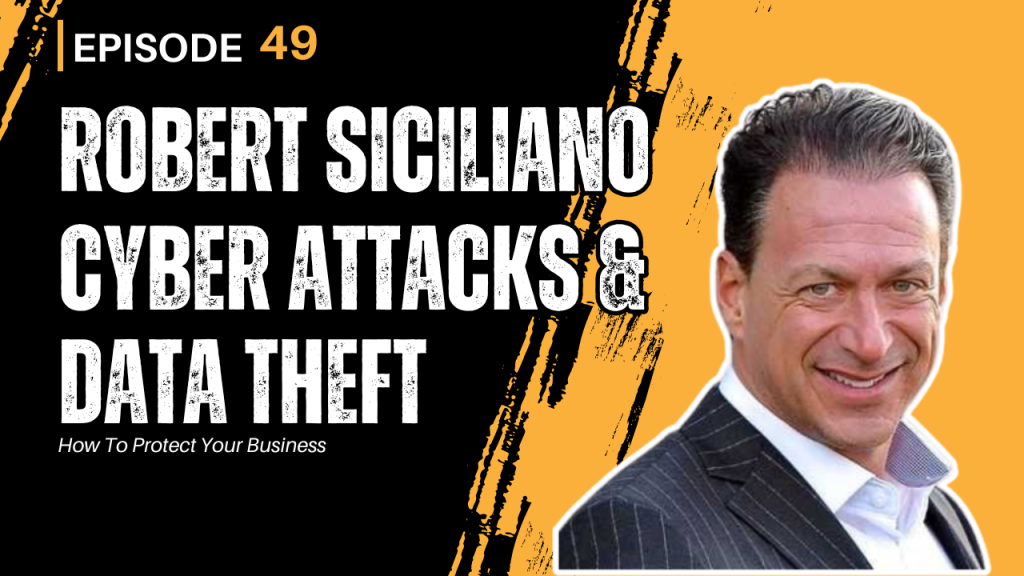
This episode of DissedMedia: A Startup Story features cybersecurity expert and bestselling author Robert Siciliano on the threats small businesses face and the steps that actually reduce risk.
Key Takeaways
- Cyber attacks now threaten small businesses, making cybersecurity essential for all organizations.
- Robert Siciliano highlights that 15 billion stolen credentials circulate on the dark web, impacting business employees.
- Traditional employee security training often fails; Siciliano advocates for ‘security appreciation training’ to engage employees actively.
- AI is revolutionizing cyber attacks, enabling criminals to craft convincing phishing scams and voice clones to deceive employees.
- Business owners should prioritize open discussions about cybersecurity and foster a culture of vigilance, rather than relying solely on compliance measures.
Cyber attacks are no longer just a big business problem. In Episode 49 of DissedMedia: A Startup Story, cybersecurity expert Robert Siciliano joins host Ben Olmos to break down exactly how cyber attacks, data breaches, and AI-powered fraud are hitting small businesses right now, why cybersecurity for small business has never been more urgent, and why most employee security training is leaving your organization dangerously exposed. If you run a business and you think you’re too small to be a target, this conversation will change your mind.

From the Streets of Boston to the Front Lines of Cybersecurity
Siciliano’s path into cybersecurity wasn’t a traditional one. No CIA background, no military career. He grew up in Boston, started his professional life teaching personal protection to real estate agents, and got hacked in 1995 losing over $3,000 in credit card fraud within a month of getting his first internet connection. That experience changed everything.
“I realized if this can happen to me, it can happen to anybody,” Siciliano said. “And the speed and efficiency of it, the lack of accountability, I knew this was going to be huge.”
Thirty years later, cyber attacks are bigger and more sophisticated than most people ever imagined.
15 Billion Stolen Passwords. Yours Might Be One of Them.
One of the most jarring moments of the conversation came when Siciliano described downloading 21 million credentials from the dark web to use as a teaching tool in his presentations. He uses the data to show audience members in real time that their email addresses and passwords are already circulating among criminals, making data breach prevention not just important but urgent for every business regardless of size.
“There are 15 billion stolen credentials on the dark web,” he said. “This is everybody.”
For business owners, that number isn’t abstract. It means the receptionists, sales reps, and managers on your team are likely already compromised in some way, and they don’t know it. Effective data breach prevention starts with accepting that reality.
Why Employee Security Training Is Making the Problem Worse
Siciliano has spent decades watching companies check the compliance box on employee security training without actually changing behavior. His critique is pointed: most employee security training is a monologue, not a dialogue. Companies push information at employees without making it personal, relevant, or engaging.
His solution is what he calls “security appreciation training,” a shift in mindset that treats employees as partners in risk management rather than liabilities to be managed. The goal is to make cybersecurity for small business feel like something your team wants to engage in, not something being forced on them.
“Make security personal to the decision makers,” he said. “That COO has a family member dealing with these exact same problems. We all do.”
AI Deepfakes, Voice Cloning, and the New Face of Cyber Attacks
The most urgent part of the conversation centered on how artificial intelligence is supercharging cyber attacks in ways that businesses are completely unprepared for. Criminals are now using generative AI to craft flawless phishing emails with no grammar mistakes and no obvious red flags. They are using voice cloning to impersonate CEOs with near-perfect accuracy, calling employees and requesting wire transfers, passwords, or sensitive payroll information. With just seconds of audio scraped from a public video, a criminal can build a convincing voice clone of anyone in your organization.
“Your employees aren’t prepared for that,” Siciliano warned. “Because we’re just hitting them on the head with a hammer.”
He also introduced the concept of the “loneliness loophole,” the idea that roughly 25% of people wake up lonely every day and that criminals are exploiting that vulnerability through AI-driven social engineering. These are not rushed scam attempts. They are patient, calculated, and increasingly automated, making data breach prevention harder than ever without the right employee security training in place.
What You Can Do Right Now
Siciliano’s advice for business owners is direct. Start by having a real conversation about cyber attacks with your team, not a training module, an actual conversation. Share the dark web statistics. Make it personal. Connect cybersecurity for small business to things employees already care about, their families, their finances, their own digital lives.
Build toward a culture of genuine vigilance. Use phishing simulations. Implement password managers. Make sure your leadership is funding employee security training not as a compliance expense but as a core business protection strategy.
“The worst thing you can do is nothing,” he said.
Listen to the Full Episode
Robert Siciliano’s full conversation with Ben Olmos is available now on DissedMedia: A Startup Story. Find it on YouTube, Apple Podcasts, Spotify, and Podbean. Connect with Robert at ProtectNowLLC.com or follow him on LinkedIn where he publishes his latest cybersecurity insights to an audience of over 15,000 followers.
Podbean
YouTube
Frequently asked questions
Are small businesses really targeted by cyber attacks?
Yes. Small businesses are frequently targeted precisely because they often have weaker defenses than large enterprises. Attackers use automated tools that scan for vulnerabilities regardless of company size, and small businesses are less likely to have dedicated security staff or incident response plans.
What is the most common way small businesses get hacked?
Phishing emails remain the most common entry point, followed by credential stuffing, where attackers use stolen username and password combinations from other breaches to access accounts where employees reused passwords. Both are preventable with training and multi-factor authentication.
What is the single most effective cybersecurity step for a small business?
Multi-factor authentication on all business accounts, especially email, banking, and any cloud tools with customer data. It blocks the vast majority of credential-based attacks even when a password has been compromised.
What is security appreciation training?
Security appreciation training, as described by Robert Siciliano, is an approach to employee security education that focuses on building genuine awareness and engagement rather than compliance checkbox training. The goal is employees who recognize threats instinctively rather than clicking through annual modules.