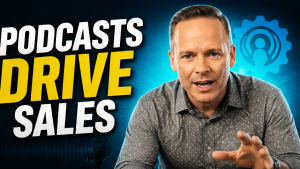


Podcast SEO in 2026 means optimizing your show so that AI systems, not just traditional search engines, can find it, understand it, and cite it when someone asks a question. That means keyword-driven episode titles, descriptions written for both humans and machines, published transcripts, timestamped chapters, and a written home for every episode on a site you control. The mechanics have shifted, but the goal has stayed the same for forty years: be findable at the exact moment someone is looking for what you know.
Few people have watched that shift play out longer than Mitch Carson. Known as the instant celebrity maker, Mitch has spent more than four decades building authority for other people across radio, television, publishing, and now podcasting. In Episode 85 of DissedMedia: A Startup Story, he joins Ben Olmos to talk about what carries forward from each era of media, what gets left behind, and why the creators who win right now are the ones who treat visibility as an operational discipline rather than a lucky break.

Pivot or Perish: Forty Years of Watching Media Reinvent Itself
Mitch traces a line from radio through television, cassettes, CDs, digital downloads, and finally podcasting. Each transition looked disruptive from inside it and obvious in hindsight. What stays constant is that every generation adopts its own channel, and the creators who refuse to move with them quietly disappear from the conversation.
He shares a moment that reframed his own thinking. He met a twenty-eight-year-old who had never watched broadcast television, not as a stylistic choice but simply because it was never part of his life. For someone who built a career partly on getting people booked onto TV segments, that was a signal worth taking seriously. Attention had already relocated, and the people still optimizing for the old channel were optimizing for an empty room.
This is why Mitch keeps returning to the phrase pivot or perish. The medium is temporary. The skill of packaging expertise so that an audience finds it and trusts it is permanent. Every era simply changes the container.
The Barrier to Entry Collapsed, and Most People Still Quit
Getting on the radio once required credentials, relationships, and a producer willing to take a risk on you. Landing a television segment required all of that plus timing. Today, anyone with a laptop and a microphone can publish a podcast to every major platform within an afternoon.
Mitch points out the catch that most people miss. Access got dramatically easier while follow-through did not. The overwhelming majority of new podcasts stop publishing within the first several episodes, with a sharp drop-off somewhere around episode three and another around episode eight. The shows do not fail because the hosts lack talent. They fail because nobody built a system that makes episode nine easier to produce than episode one.
That observation reframes the entire conversation. If almost everyone quits before they build an audience, then simply continuing to publish becomes a competitive advantage. Consistency is the moat.
Why Podcast SEO Starts With a Repeatable Production Workflow
Ben walks through the pipeline he built for DissedMedia, and it is worth paying attention to because it explains how podcast SEO actually gets executed week after week without burning out the host.
The episode gets recorded and a transcript is generated immediately. That transcript becomes the raw material for everything downstream. Show notes are written with target keywords built in. The YouTube version gets its own title, description, and chapter markers, because YouTube search behaves differently from Apple Podcasts search and deserves separate treatment. Thumbnails are produced to a consistent template. A full blog post is published to WordPress, which then pushes automatically to Substack. Clips are cut for social distribution.
None of that is glamorous. All of it is repeatable, which is the point. Ben approaches the show the way he approaches any operational problem, breaking a complex process into functional components and building a workflow that survives a bad week. Claude MCP connectors sit underneath the whole thing, running the WordPress site, the online store, and the podcast booking platform, with a Descript connector handling transcript retrieval directly.
The takeaway for anyone building a show is straightforward. Podcast SEO is not something you bolt on after recording. It is a set of steps that live inside your production process, executed the same way every time, so that search visibility compounds instead of depending on whether you felt motivated that week.

Substack Over Spotify: Rethinking Where Distribution Lives
Ben explains why he pulled the show off Spotify following a licensing dispute, and what happened afterward. Growth on Substack has outpaced what Spotify was delivering, which is a useful data point for creators who assume the largest platform is automatically the most valuable one.
He also walks through the technical piece that trips people up. Getting a video-first podcast onto Substack correctly requires attention to how the RSS feed exposes the audio track, and getting that wrong means listeners get a broken experience. The workaround is not complicated, but it is the kind of detail that separates a show that grows on a platform from a show that merely exists on one.
The broader lesson is about ownership. Platforms change their terms, their algorithms, and their economics without asking. Distribution that runs through a site you control, feeding outward to platforms rather than depending on them, gives you somewhere to stand when one of those changes goes against you.
Podcast SEO Is Now About Ranking Inside AI Answers
The most forward-looking stretch of the conversation covers where discovery is heading. Both Mitch and Ben describe using Claude and ChatGPT as a kind of standing advisory board, running ideas, positioning, and content angles past both models and comparing the responses.
More importantly, they dig into what it means to be visible inside AI-generated answers. When someone asks an AI assistant for the best podcast on a topic, or for an expert on a particular subject, something has to be in the model’s reachable information for you to appear. That is a different optimization target than a blue link on page one of Google, and it rewards different things: clear structured content, direct answers stated plainly near the top of a page, published transcripts, and consistent authoritative signals across the web.
Ben describes using Semrush alongside Claude connectors for keyword research, pulling volume and difficulty data directly into the drafting process rather than treating research as a separate task done once a quarter. He also makes the case for grading your own site with AI tools on a monthly cadence, because the gap between what AI crawlers index and what they actually cite is where most of the practical work sits right now.
We covered a related angle in How Experienced Professionals Get Found in AI Search, which goes deeper on the structural side of AI visibility. For the writing mechanics behind it, SEO Content Writing Strategies That Actually Drive Traffic covers what we learned building this publication.
Building Authority Architecture Before You Need It
Mitch shares the origin of the instant celebrity maker label, which came from years of packaging clients so that media outlets had a reason to book them. The underlying method has not changed much. You establish credibility markers, you make them easy to verify, and you place them where the people evaluating you will look.
What has changed is who is doing the evaluating. It used to be a producer with a segment to fill. Increasingly it is a language model assembling an answer. The work of building authority architecture, meaning a consistent, verifiable footprint of expertise across multiple properties, now serves both audiences at once.
Mitch closes the conversation with an offer to bring Ben back for a longer interview focused entirely on the production workflow, paired with a paid press release and syndication package. His framing is that the operational knowledge Ben has built running the show is itself a product other creators would pay for, which is worth considering if you have quietly become good at something while building your own thing.
What This Means for Your Show
If you take one thing from Episode 85, make it this. Podcast SEO rewards systems over inspiration. Build the workflow that gets an episode from recording to published, transcribed, written up, clipped, and distributed without heroics. Then keep running it. The shows that survive past episode eight are already ahead of most of the field, and the ones publishing structured, keyword-aware content on a site they own are positioned for whatever discovery looks like two years from now.
Frequently Asked Questions
What is podcast SEO?
Podcast SEO is the practice of optimizing your show’s titles, descriptions, transcripts, show notes, and supporting web content so that people can find it through search. That includes podcast directory search inside Apple Podcasts and Spotify, video search on YouTube, traditional web search, and increasingly the answers generated by AI assistants.
Do podcast transcripts help SEO?
Yes, and they are one of the highest-leverage assets you can publish. Search engines and AI systems cannot fully parse audio, so a published transcript turns your entire episode into indexable text. It also gives you the raw material for show notes, blog posts, and clip selection, which makes it useful operationally as well as for search.
How do you get a podcast to show up in AI search results?
Publish a written version of every episode on a site you control, answer the core question of the episode directly in the opening paragraph, use clear headings that match how people phrase questions, include transcripts and timestamps, and keep your credibility signals consistent across platforms. AI systems assemble answers from reachable, well-structured content, so the goal is to make your expertise easy to parse and easy to attribute.
How many episodes does it take before a podcast starts growing?
There is no fixed number, but the drop-off data is instructive. Most podcasts stop publishing within the first eight episodes, which means consistency alone puts you ahead of the majority. Growth generally follows from a repeatable production and distribution workflow rather than from any single episode breaking through.
Watch the Full Episode
Connect with Mitch Carson at MitchCarson.com and on The Amazing Authorities.