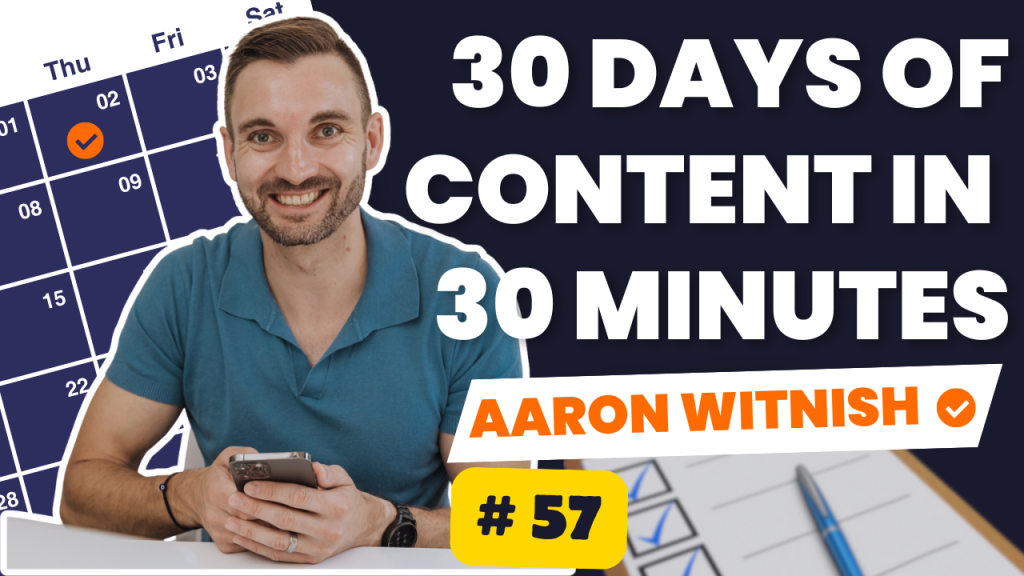

Most business owners know they need a social media content strategy, but the camera sits untouched, the posting schedule stays empty, and the excuses pile up. The fear of looking foolish, saying the wrong thing, or simply not knowing where to begin keeps talented people invisible online while less qualified competitors fill the feed. Aaron Witnish has spent over a decade solving exactly that problem. In Episode 57 of DissedMedia: A Startup Story, Aaron joins Ben Olmos to break down his signature 30 Days of Content in 30 Minutes system, explain how AI content creation has changed what is possible for small teams, and make the case that personal branding online and video content marketing are no longer optional for business owners who want to grow.

Who Aaron Witnish Is
Aaron Witnish is a content strategist and agency owner based in Australia who has been helping business owners build their online presence since 2012. His agency operates on a done-for-you model, producing social media content, video reels, and written posts for clients across Australia, the United States, and Europe. What separates Aaron from most content coaches is that he gives away the entire system for free, including the tools, the frameworks, and the process, because he believes that generosity at scale is the most reliable path to sustainable business growth.
His story did not start with confidence. It started in a bedroom in his parents house, filming on a dated laptop with a webcam, wearing a suit, mouth out of sync with the audio, and posting the video anyway. The first comment he received was not a compliment. Most people would have quit. Aaron did not.
The Fear Is Normal and It Does Not Go Away on Its Own
Camera fear is nearly universal among business owners who have not built a content habit yet. Aaron puts it plainly: in over a decade of working with clients, he has met only two exceptions to the rule that people are terrified to put themselves online professionally. The fear is not about vanity. It is about visibility. When competitors, clients, and former colleagues can all see what you are putting out there, the stakes feel enormous.
The reframe Aaron uses with clients is simple and powerful. Stop making it about yourself. Ask who you are there to serve and what one idea you share might change one person’s perspective or trajectory. When the focus shifts from self-judgment to service, the camera becomes less threatening. The goal is no longer to look good. The goal is to be useful.
He compares building a video content marketing habit to going for a run after years off the couch. The first few hundred meters will be painful. The content will not be polished. That is expected and acceptable. The people watching are not nearly as critical as the person hitting record. Most of them are quietly impressed that someone is doing something they are too afraid to try themselves.
The 30 Days of Content in 30 Minutes System
The origin of Aaron’s signature social media content strategy for business owners came from a Zoom call with a client named Mark, an Australian bricklayer who wanted to build his personal brand in the Melbourne construction industry. Aaron started asking Mark questions off the cuff, hit record, and let the conversation run for twenty minutes. He sent the recording to his editor the next day with a simple question: can you cut any clips from this?
The editor came back with twelve reels, fully branded and captioned. That single conversation became a month of content. The 30 Days of Content in 30 Minutes system was born.
The DIY version Aaron shared on the podcast is completely free and accessible to anyone:
Set up a Google Meet with a colleague or friend and hit record. Use Aaron’s custom GPT to generate the top 30 questions people are searching online for your specific niche. Pull a handful of those questions, let the conversation run naturally, and stop after about thirty minutes. Google Meet will auto-transcribe the session. Drop that transcript into a second GPT Aaron has built specifically for this system and it will format every question into a complete social media post with the hook, structure, call to action, and hashtags already built in. Take the video file, upload it to a tool like Opus Clip, and the platform will cut branded reels with captions automatically. The result is thirty days of video content marketing and written posts from one conversation that cost nothing but time.
How AI Content Creation Fits Into a Real Workflow
AI content creation is not a magic button. That is one of the clearest and most useful points Aaron makes in the episode. When ChatGPT launched, it disrupted the core of what Aaron’s agency did, which at the time included writing social media posts for clients. Instead of panicking, his team adapted. They now use AI to train deeply on each individual client before producing anything.
The onboarding process extracts the client’s ideal customer profile, their primary offers, their tone, and their competitive differentiators. Once the AI knows a client inside out, it becomes a significantly more effective tool for content research, transcript repurposing, and post formatting. The human team still cuts the video clips by hand because AI-generated clips tend to be random rather than strategic. Quality control, scheduling, and final review stay with the people. AI handles the repetitive, time-consuming steps that used to take half a day.
The framing Aaron uses internally is that AI is an employee. When it misses the mark, which it will, the response is not frustration. It is feedback. Reinstructing, correcting, and iterating is how AI content creation becomes useful rather than generic. Anyone trying to use AI without the underlying skill set will get a poor result because they will not know what good looks like. The output is only as strong as the direction behind it.
Personal Branding Online and the Abundance Mindset
Aaron makes a counterintuitive argument about personal branding online that runs directly against the instincts of most business owners: give away your best content for free. Not a watered-down version. The full strategy, the frameworks, the step-by-step process, everything. His reasoning is that if you help a hundred thousand people for free, the business takes care of itself.
The people who consume free content and act on it themselves were never going to become paying clients anyway. The people who consume free content and realize they do not want to do it themselves will come looking for help. Giving away the do-it-yourself version accelerates both outcomes. It builds trust faster, creates referral momentum, and positions the business as the obvious choice when someone is ready to invest.
This approach also matters in an era when AI-generated content is flooding every platform. Authentic, unpolished video from a real person who clearly knows what they are talking about cuts through synthetic content in a way that no production budget can replicate. Aaron has seen this pattern consistently across his own channels. The raw videos outperform the polished ones because they feel real. Personal branding online in 2026 is not about looking impressive. It is about being believable.
The Tools Aaron’s Agency Uses Every Day
For anyone building a video content marketing workflow from scratch, Aaron’s recommended stack is practical and accessible. ChatGPT with custom GPTs built for content research and transcript repurposing is the core engine. Opus Clip handles video editing and branded captions with enough flexibility for custom fonts, colors, and B-roll. Canva covers visual content and additional branding needs. Google Meet handles recording and auto-transcription. Rev.com fills the gap when a recording needs to be transcribed manually with high accuracy.
Ben adds Descript and CapCut to that list. Descript for first-pass editing directly from the transcript and CapCut for adding lower thirds and titles to the final video. The point both of them make is that the specific tools matter less than having a system. There are enough affordable, accessible options available today that budget is no longer a real barrier to a professional social media content strategy for business owners at any stage.
What Gets Aaron Out of Bed Every Morning
The most memorable part of the conversation has nothing to do with tools or tactics. Aaron describes a shift that happened in his business when he stopped optimizing for revenue targets and started asking how many people he could help for free. That shift changed the energy behind everything he does. The work pulls instead of pushes. He drops his son at school, creates content for a few hours, picks his son up in the afternoon, and ends the day clear on what he contributed.
He credits a mentor-led visioning process with helping him get specific about what he actually wanted from his life rather than chasing someone else’s definition of success. The result is a lifestyle business that aligns with his values, produces meaningful impact, and compounds over time. He is not building an empire. He is building something he genuinely wants.
Ben echoes the same philosophy, pointing to Dan Pink’s book Drive as a framework for understanding why purpose-driven work feels different from hustle. When the mission matters and the work has meaning, twelve hours at the desk does not feel like twelve hours. The hours just disappear.
The Bottom Line
A social media content strategy for business owners does not require a film crew, a production budget, or hours of effort every week. It requires a system. Aaron Witnish has built one that works, tested it with clients across industries and continents, and is giving the entire thing away for free. The 30 Days of Content in 30 Minutes framework, combined with the right AI content creation tools and a commitment to showing up authentically, is enough to build real personal branding online and sustainable video content marketing momentum from a single conversation every month.
The camera is not the enemy. The system is just missing.
Listen to Episode 57 on Apple Podcasts, Spotify, and YouTube. Search DissedMedia: A Startup Story or visit dailypitch.news for all episodes and show notes.
Connect with Aaron Witnish Website: aaronwitnish.com