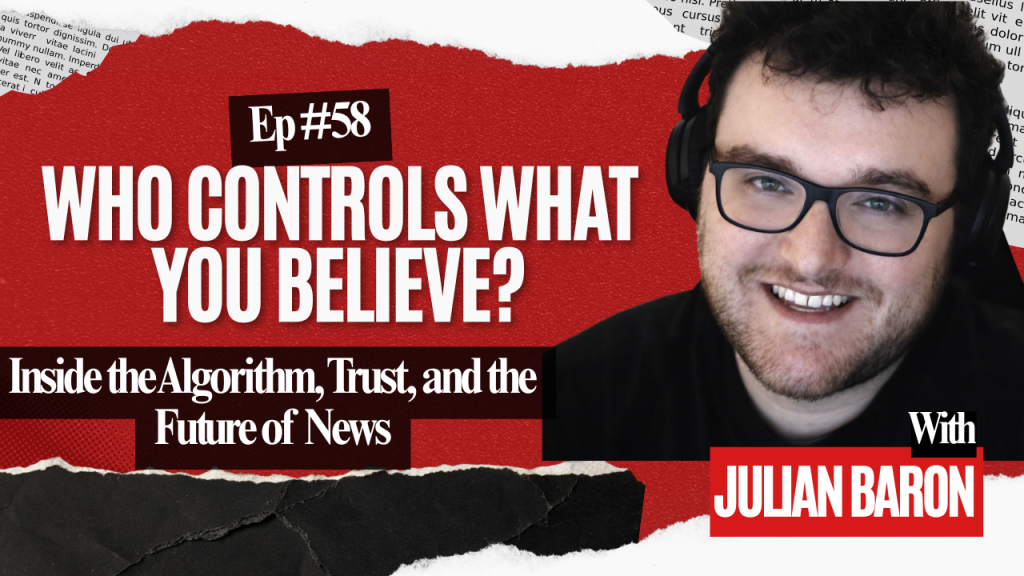

Understanding how social media algorithms control the news is no longer just a media industry problem. It is a business problem, a leadership problem, and a critical thinking problem for anyone who makes decisions based on the information they consume every day. Trust in media has never been lower, the collapse of local news is accelerating across the country, and the independent journalism future that replaces it is still taking shape. In Episode 58 of DissedMedia: A Startup Story, host Ben Olmos sits down with Julian Baron, Managing Editor of Off The Press and Baltimore Sun contributor, to map out exactly how the information ecosystem got here and what leaders need to know to navigate it.
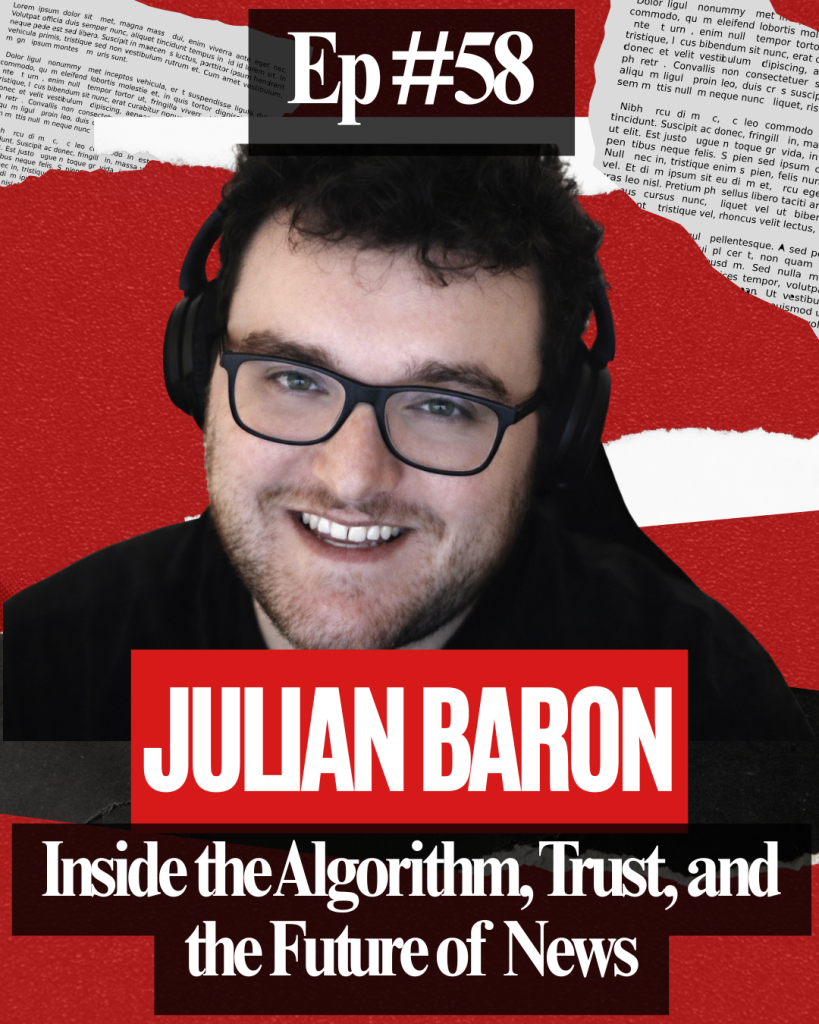
Who Is Julian Baron
Julian Baron brings a rare combination of insider knowledge and entrepreneurial thinking to the media conversation. He has worked inside media organizations at multiple levels, including time at the Tucker Carlson Network, and has written extensively on journalism and media trust as a contributor to the Baltimore Sun editorial board. He is also the Managing Editor of Off The Press, a donor-funded digital news operation built specifically to deliver responsible, factual journalism inside the social media environments where most Americans now get their news. His work sits at the intersection of editorial integrity, audience behavior, and platform strategy, which makes him exactly the kind of voice that managers, leaders, and entrepreneurs need to hear when thinking about how information shapes the decisions they make.
The Moment Social Media Became America’s Primary News Source
One of the most significant data points Julian raises in the conversation is that 2025 marked the first time in American history that a majority of citizens named social media as their primary source of news. This is not a trend anymore. It is the new baseline. For anyone in business trying to communicate credibly with customers, employees, or the public, this shift changes everything about how information flows and how trust in media gets built or destroyed. The audiences that companies are trying to reach are no longer picking up newspapers or watching the six o’clock news. They are scrolling through feeds designed by algorithms that prioritize engagement over accuracy, emotion over facts, and stickiness over truth.
How Social Media Algorithms Control the News Feed
The core of Julian’s argument is that understanding how social media algorithms control the news is the first step toward defending yourself against the distortions they create. Algorithms do not ask whether a piece of content is accurate. They ask whether it generates engagement. Likes, comments, shares, and watch time are the metrics that determine what gets amplified and what disappears. This means that emotionally charged content, regardless of its relationship to the truth, consistently outperforms measured and factual reporting. Julian describes watching Off The Press posts closely to determine which algorithm the content has landed in, noting that the comments on TikTok in particular reveal almost immediately whether the post has been fed to a liberal or conservative audience bubble. There is rarely a middle. There is rarely a mix. The algorithm has already decided who should see it and how they should feel about it.
Julian also draws a sharp distinction between the platforms in terms of how they handle this dynamic. TikTok, he argues, is the most extreme example of pure emotional engagement driving distribution. Instagram, Facebook, and X tend to feed content to audiences already predisposed to agree with it. The result across all of them is a worldview that feels far more unanimous than it actually is, because the algorithm only shows people the portion of reality that keeps them scrolling.
Trust in Media and the Censorship Pendulum
One of the most nuanced parts of the conversation involves the question of trust in media and the failed experiment with content moderation. Julian argues that one of the most significant mistakes made during the social media era was the move toward censoring content flagged as misinformation. The intention may have been responsible, but the execution created a backlash so severe that the platforms swung to the opposite extreme. Where there were once editors and gatekeepers deciding what met the standard for publication, there is now, as Julian puts it, the wild west. Anyone can say anything. The algorithm will distribute it based on how many people engage with it. Trust in media, already fragile, took another hit as audiences stopped believing that any institution had the authority or integrity to tell them what was true.
The constructive path forward, Julian believes, is not more censorship but better competition. Responsible journalism has to fight for algorithmic space the same way misinformation does. Off The Press approaches this directly, producing content that is designed to be accurate and factual while also being formatted in ways that give it a real shot at distribution. Social cards, breaking graphics, and visual hooks are tools that legacy journalism often dismisses but that Off The Press uses deliberately to compete inside the environments where the trust in media battle is actually being fought.
The Collapse of Local News and What Fills the Void
The collapse of local news is one of the clearest examples of how the shift to social media distribution has real consequences for communities and businesses alike. Local newspapers and television stations have been closing or scaling back at a dramatic pace. The communities they once served are becoming what Julian calls news deserts, places where there is no reliable local source for what is happening in city hall, in the school board, or in the neighborhoods where people live and work. The collapse of local news does not mean that people stop wanting to know what is happening locally. It means they get that information from sources that are less verified, less accountable, and more likely to reflect the distortions of whatever algorithm served the content to them.
Julian connects the collapse of local news directly to the economics of broadcasting. Local television stations, he explains, are not primarily funded by advertising revenue from car companies and pharmaceutical brands, as is commonly assumed. They are funded by carriage fees paid by cable providers, fees that are themselves tied to the value of carrying sports programming on broadcast networks. When the NFL finishes its current migration toward streaming services, which Julian predicts will be complete by the early 2030s, those carriage fees collapse with it. Local news, which has been quietly subsidized by the sports broadcasting model, loses its financial floor. The collapse of local news that is already underway will accelerate dramatically when that happens.
The Independent Journalism Future and What It Looks Like
The independent journalism future that Julian describes is not a single institution or a new media company. It is a patchwork. It looks like individual creators who cover local areas with the same tools and platforms available to any content creator, monetizing through YouTube revenue, direct support, and community subscriptions. It looks like donor-funded operations like Off The Press, built lean enough to survive without advertiser or corporate pressure, and focused enough to serve audiences that legacy media has abandoned. The independent journalism future is already arriving, Julian argues, and the question is not whether it will replace local news but whether the responsible voices get there first.
Ben Olmos connects this directly to his own experience building DissedMedia as an independent media operation. The channel shift from written content to video and podcasting mirrors exactly what Julian describes about how audiences are consuming information today. The independent journalism future rewards creators who understand their audience, meet them on the platforms they already use, and build trust through consistency and accuracy rather than institutional brand recognition.
What Business Leaders Should Take Away
The conversation between Ben and Julian is not a media industry conversation in isolation. It is a leadership conversation. How social media algorithms control the news has direct implications for the quality of information that reaches teams, customers, markets, and decision-makers. Business leaders who understand this dynamic are better equipped to ask harder questions about where their information comes from, to be more skeptical of consensus that forms too quickly on social platforms, and to support the independent journalism future that serves their communities and industries with accurate information.
Trust in media cannot be assumed. It has to be earned and it has to be protected. For managers and entrepreneurs who rely on an informed market and an informed workforce, understanding the collapse of local news and the forces reshaping how information travels is not optional. It is part of operating with clarity in a complicated world.
Listen to Episode 58
Episode 58 of DissedMedia: A Startup Story is available now on all major podcast platforms. Explore Off The Press at offthepress.com and follow Julian Baron on X at @JulianTBaron.
Subscribe to The Daily Pitch on YouTube and help Ben reach 100,000 subscribers at youtube.com/@DissedMedia.