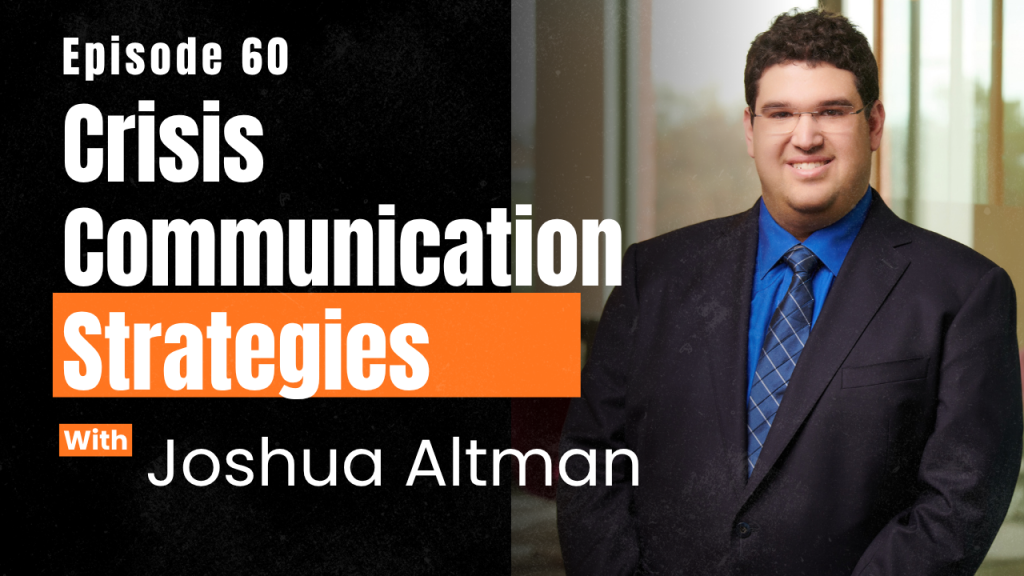

Joshua Altman has spent his career watching founders make the same costly mistake: they start thinking about startup communications when they are ready to launch their brand. By that point, according to Altman, they have already started too late. In Episode 62 of DissedMedia: A Startup Story, the founder of Beltway Media joins host Dr. Ben Olmos to break down why the story always comes before the brand, how to survive a crisis without making it worse, and what it actually takes to build a narrative that connects with every stakeholder in your business.

Who Is Joshua Altman?
Joshua Altman is the founder of Beltway Media, a fractional chief communications officer firm that helps startups and small to medium businesses shape perception and build lasting trust. His path into startup communications was anything but conventional. He started as a multimedia journalist covering Congress for The Hill newspaper, doing video, photo, web, and audio production before anyone had a clean way to do any of it. Early live streaming meant a different laptop hardwired to every camera, dedicated internet lines at venues, and not enough chairs to hold all the equipment. He sat on the floor managing the feed.
When a corporate client approached him for a project, he realized there was a gap in the market: companies needed someone who could bridge technical production skills with strategic storytelling and communicate across every stakeholder from the web development team to the C-suite. One project became two, then three, and Beltway Media was born. It was not a plan, as Altman says freely. It just happened to be exactly what the market needed.
Story First, Brand Second
Altman structures everything his firm does around a three-tier framework: story, narrative, and brand. Most founders show up at the brand level. They want the logo, the messaging, the social presence. What they actually need to start with is the story.
Story is simply what happened. How the company started, who built it, what problem they set out to solve, and why. Narrative is the structured version of that story, the once upon a time that answers the questions customers, investors, and partners are quietly asking every time they encounter the brand. Brand is what Altman calls the swag: the stuff people actually engage with. And if you try to build the swag without the story and the narrative underneath it, you end up with something that looks polished but does not connect to anything real. This is where startup communications breaks down for most early-stage companies.
His process starts with conversations. He sits with founders and early employees and gets them talking about why they started the company. The story is always in there. Some people got frustrated with the way something was done and decided to fix it. Others reset after something difficult and ended up somewhere they never expected. That why is what Beltway Media is trying to excavate and translate into something that can be communicated consistently across every channel and every audience.
The Authenticity Problem
One of the most common questions Altman hears from clients is how to be authentic without looking like they are trying too hard to be authentic. It is a real tension in startup communications, and there is no formula for resolving it.
Authenticity is not about being raw or unpolished. It is about finding the right tone and the right level of production for the specific company and the specific audience. A B2B software tool does not need to feel like a best friend. It needs to feel reliable and useful. A consumer health product might need a completely different emotional register. The line between authentic and forced is different for every brand, and it moves as audiences evolve.
What Altman pushes back on is the idea that authenticity can be manufactured. Audiences recognize when a brand is performing emotion rather than expressing it. The antidote is doing the foundational work of understanding who the company actually is, what it actually believes, and communicating that clearly rather than chasing whatever the current trend says authenticity should look like.
Handling a Crisis Without Making It Worse
Crisis response is where startup communications breaks down most visibly, and where Altman sees the most preventable mistakes. The first distinction he draws is between a real crisis and a founder crisis. A real crisis is something that people outside the company will care about. A founder crisis is something that feels catastrophic internally but will have zero traction externally.
If no one outside the company is paying attention, the worst thing a founder can do is draw attention to the situation by responding publicly. Do not throw gas on a fire nobody else has noticed yet. When a real crisis does require a response, the approach is straightforward: be transparent, put the situation in context, and do not rush through the difficult news hoping no one will ask about it. Investors and stakeholders already know the numbers. Minimizing a hard quarter or a significant layoff does not protect anyone. It damages trust.
Altman’s firm runs crisis communications drills with clients before anything happens. The goal is to have a plan on the shelf so that when something goes wrong, the response is measured and strategic rather than reactive. Time is the most underrated tool in crisis management. Sleeping on a response before releasing it eliminates half the damage most crisis responses cause.
Know Who You Are Talking To
One of the patterns Altman sees repeated most consistently among founders is the assumption that their audience shares their level of expertise and enthusiasm for what they have built. They do not, and the startup communications strategy that comes out of that blind spot misses the audience every time.
When a founder is selling a Bluetooth device that connects to a smartphone, the customer does not care about the chip architecture. They care whether the device works and what it does for their life. The founder who spent two years engineering that chip architecture is going to have a hard time remembering that. The fix is not complicated, but it requires discipline: constantly ask who you are talking to and what that specific person actually cares about. That question should drive everything from pitch language to social content to how the company responds to a customer complaint.
The Fractional CCO Model
Beltway Media operates on a fractional model, which means clients can engage at whatever level the business actually needs. Some start at five hours a month. Some grow to twenty or thirty hours a week. The goal of the engagement, counterintuitively, is eventually to put itself out of a job. When a company grows large enough to need a full-time chief communications officer in house, Beltway Media helps navigate that transition.
Altman makes the case that the founders who think they cannot afford startup communications support at the early stage are exactly the ones who need it most. The foundation built in those first five hours a month is what everything else rests on. Coming in later is never too late, but it is always more work.
Where to Find Joshua Altman
Joshua Altman is the founder of Beltway Media, a fractional chief communications officer firm working with startups and small to medium businesses. Free self-assessment tools for startups are available on the website.
Website: beltway.media Email: jaltman@beltway.media LinkedIn: linkedin.com/in/joshuaialtman