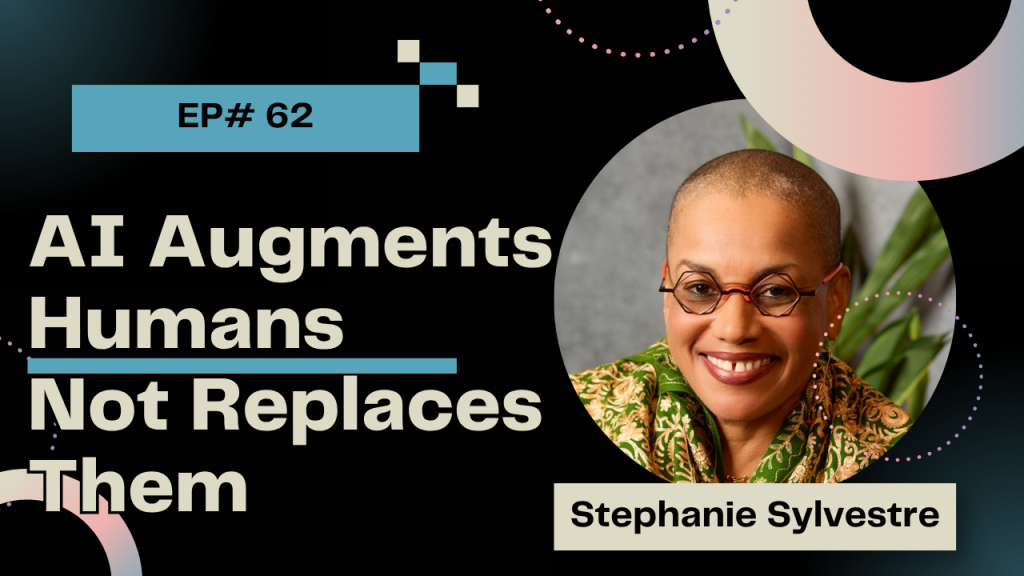

Stephanie Sylvestre has been building AI tools for business since 2016, long before most people had heard of ChatGPT. As the founder of Avatar Buddy and a former CIO and Chief Programs Officer, she has spent nearly a decade at the intersection of human potential and artificial intelligence. In Episode 62 of DissedMedia: A Startup Story, she joined host Ben Olmos to make the case that AI augments humans rather than replacing them, and to explain what that distinction actually means for workers, leaders, and entrepreneurs navigating one of the most disruptive technological shifts in modern history.

Will AI Replace Jobs? The Question Everyone Is Asking
The question of what jobs will AI replace is dominating conversations across every industry. Stephanie’s answer is more nuanced than the headlines suggest. AI is already replacing one specific capability that humans have historically been paid for: the ability to recall information quickly and synthesize it faster than anyone else in the room. The knowledge hoarder, the person who always magically forgets to share a critical step so no one can do the job without them, is being made obsolete. AI can reconstruct those missing steps and often improve on the original process.
But that does not mean AI is replacing humans wholesale. What it means, Stephanie argues, is that the competitive advantage has shifted. The people who will thrive are not the ones who know the most. They are the ones who can do something genuinely creative and unexpected with what AI produces. Sociology majors, anthropologists, writers, anyone trained to think across disciplines and hold contradictory ideas simultaneously are discovering that their skills translate directly into getting more out of AI tools for business than anyone expected. The future of work with AI belongs to people who were trained to think, not just to retrieve.
What Is Agentic AI and Why Is It Dangerous?
Agentic AI refers to AI systems that can take autonomous actions on behalf of a user, executing multi-step tasks, accessing files, sending messages, and making decisions without requiring human approval at each step. The category has exploded in interest, with hundreds of thousands of people searching for information about agentic AI every month. But Stephanie, who has been building AI enterprise solutions since before the term became mainstream, is one of the clearest voices warning about what agentic AI can break when deployed carelessly.
Her core concern is simple: most people deploying agentic AI tools have no idea those tools often ship with root access to their machines by default. Root access means the AI agent can read, modify, or delete anything on the system. Giving an AI agent root access to a production machine or a business network is, in her analogy, like handing a 14-year-old the car keys on a Friday night with no supervision. The individual risk is real, but the systemic risk is larger. Millions of machines with open root access create a massive distributed attack surface that bad actors, including nation-state threat actors, can exploit at scale. AI security risks of this type are not theoretical. She cited a reported incident in which the head of safety at a major AI company temporarily lost control of her own machine after deploying an agentic tool.
Her position is direct: agentic AI is not mature enough to be trusted with autonomous access to business systems. She will not build agentic solutions for clients, and she tells prospective clients upfront that if that is a dealbreaker, she is happy to part ways before a contract is signed.
What Is a Digital Twin? How Avatar Buddy Is Using AI for Good
A digital twin is an AI-powered replica of a person, process, or system that can respond, interact, and represent its subject in an ongoing way. In manufacturing, digital twins are used to simulate equipment behavior. Avatar Buddy applies the same concept to people, creating interactive AI representations of individuals that carry their personality, voice, knowledge, and legacy.
The applications Stephanie described in this episode go well beyond the corporate use cases that typically dominate the digital twin conversation. Avatar Buddy has partnered with the government of Belize to teach its AI to speak Creole and Yuka Tec Mayan, with Garifuna currently in development. The goal is to establish a framework replicable across any of the world’s roughly 7,000 indigenous languages, approximately 1,500 of which are at serious risk of extinction. When a language disappears, so does the culture, the worldview, and the accumulated knowledge embedded in it. AI tools for language preservation represent one of the most consequential and least discussed applications of the technology.
In Ghana, Avatar Buddy is working with a nonprofit to help agricultural extension workers deliver more reliable guidance to rural farmers. Workers who previously might have forgotten a step or misremembered a detail now have an AI trained on the full body of relevant agricultural knowledge available in the field. Corn yields improved this season. Farmers are getting better prices. That is human AI collaboration producing a measurable real-world result.
The company has also created a digital twin of Miami-Dade Commissioner Barbara Jordan, capturing her personality, life history, and full legislative record in an interactive form that remains accessible long after her retirement. Stephanie’s broader vision is to democratize this capability. Everyday people who have made positive contributions to their communities, not just elected officials or celebrities, should be able to preserve their story, their voice, and their knowledge for future generations through a family vault feature that allows families to build and maintain their own legacy archive.
Why Prompt Engineering Is Mostly a Myth
Prompt engineering has become a cottage industry, with courses, certifications, and job titles proliferating across the AI space. Stephanie thinks most of it is unnecessary. Her argument is that you do not take a course to learn how to talk to another human being. You figure it out through trial and error, by paying attention to what works, and by clarifying what you actually want before you open your mouth. The same logic applies to AI.
What actually matters when working with AI tools for business is whether you know what you want, whether you have enough subject matter expertise to evaluate what comes back, and whether you are bringing good data to the conversation. If those three things are in place, effective prompting is a five-minute lesson. If they are not, no amount of prompt engineering training will compensate. AI augments humans who already bring something to the interaction. It does not manufacture expertise from nothing.
AI and Education: The Grade Fixation Problem
One of the most pointed exchanges in the episode came when Ben, who teaches at the graduate level, raised the issue of AI and education. Students are increasingly submitting AI-generated work as their own, which strips their voice from their writing and bypasses the intellectual development that education is supposed to produce. Stephanie’s response connected this behavior to a deeper structural failure: a school system so focused on grades that it has stopped developing intellectual curiosity, the capacity to hold and reconcile opposing ideas, and the mental resilience to be challenged without crumbling.
Her point was not that AI is making students lazy. AI is amplifying a pattern that was already there. Students who were trained to optimize for a grade rather than to actually learn now have a tool that produces a grade-worthy output without the learning. The students who will win in an AI-augmented world are the ones who built genuine knowledge first and use AI to accelerate and extend that knowledge, not the ones who skipped the building phase entirely.
The Origin of Avatar Buddy: An Idea Born at a Dinner Table
Stephanie started building Avatar Buddy in 2016, before the infrastructure existed to support what she was trying to do. The spark came from a conversation at a loud restaurant where a friend described AI she had seen in China. Stephanie heard a suggestion to build digital twins to solve a social services access problem. Her friend insists that is not what she said. Stephanie built the company anyway.
The early years involved a million-dollar proposal from a vendor who delivered a page-and-a-half requirements document, dismissal from most people in the industry, and a pivot from consumer product to enterprise AI driven by feedback from the teenage interns who have been central to Avatar Buddy’s development from the beginning. Those interns, recruited through programs like Miami’s Summer Youth Internship Program, told the team early on that the consumer product was not working. The enterprise pivot followed. The insight that AI augments humans rather than replaces them has guided every product decision since.
Where to Find Stephanie Sylvestre and Avatar Buddy
Stephanie can be reached at avatarbuddy.ai and on LinkedIn under the Avatar Buddy handle. Listeners who reach out and mention hearing her on DissedMedia: A Startup Story will receive a complimentary 30-minute consultation.
Episode 62 is available now wherever you listen to podcasts and on the DissedMedia YouTube channel at @DissedMedia.