


Key Takeaways
- David Salerno emphasizes the importance of business freedom, which allows founders to operate without being the sole decision-maker.
- He scaled Solpak Packaging Solutions to eight figures while keeping the team small, focusing on systems that empower team members.
- Salerno developed the Sherpa Method, which includes growth, sustainability, and service as key challenges for achieving business freedom.
- He highlights the difference between delegating and abdicating, stressing the need for process and follow-through in delegation.
- Salerno advises founders to shift from being doers to builders to maintain business freedom and foster team autonomy.
Most entrepreneurs start a business chasing business freedom. What they find instead is a calendar that owns them, a team that cannot move without their approval, and a growing sense that the company they built has quietly become a trap. David Salerno knows that feeling well. He also knows exactly how to get out of it. In Episode 61 of DissedMedia: A Startup Story, Salerno joins host Dr. Ben Olmos to break down how he scaled Solpak Packaging Solutions from $80,000 in year one to an eight-figure business with fewer than 20 people, and how he built it in a way that gave him the business freedom to choose exactly how he showed up every single day.

Who Is David Salerno?
David Salerno is the founder of Entrepreneur Sherpa, author of Built for Freedom, Vice Chair of the Montreal Economic Institute, and a Forbes Business Council member. He launched Solpak Packaging Solutions from scratch, targeting the food packaging and meal delivery industry with clients including Meals on Wheels, correctional services, and institutional caterers needing safe, compostable meal packaging. Year one revenue came in at $80,000 with margins thin enough to make most people walk away. He did not.
Over the next two decades he scaled the company to eight figures while deliberately keeping the team under 20 people. That was not a limitation. It was a philosophy. Salerno measured success not by headcount but by revenue per team member, and he built systems that made every person on the team capable of operating without running every decision through the founder. Business freedom, in his view, was never about sitting by the pool. It was about building something that did not depend on any single person, including himself, to function at a high level.
The Bottleneck Problem Every Founder Faces
Around year three, as SolPack started gaining real traction, Salerno hit the wall that stops most growing businesses cold. Clients were waiting on answers. Team members were stacking questions on his desk. Every specialized decision flowed through one person: him.
He recognized quickly that the problem was not his team. It was the absence of systems. When there is no documented process, no source of truth, and no decision framework, every unusual situation becomes an interruption for the founder. Multiply that across a growing client base and a scaling operation and the founder becomes the single biggest obstacle to the company’s growth. True business freedom requires solving this problem deliberately, not hoping it resolves itself as the company gets bigger.
His solution was to map out the questions before they became emergencies. He documented processes, clarified roles, and created what he describes as sandboxes: clearly defined domains of ownership where each team member had the authority and the information to make decisions without waiting on him.
The Sherpa Method: Growth, Sustainability and Service
The framework Salerno developed over those twenty years became the foundation of his coaching practice and his book Built for Freedom. He calls it the Sherpa Method, built around three core challenges every founder must master to achieve genuine business freedom.
The first is growth. Without enough revenue to sustain the business and fund the team, nothing else matters. Salerno is direct about this: obsessing over logos, business cards, and branding before landing clients is one of the most common and costly mistakes early founders make. Get clients first. Build the brand as you grow.
The second challenge is sustainability. Growth means nothing if the business cannot operate without the founder in the room. This is where systems, processes, and clearly defined roles become the infrastructure of business freedom. Salerno emphasizes that sustainable businesses answer questions before they are asked, building decision frameworks that let the team move without bottlenecks.
The third challenge is service. Not just to clients, but to the people inside the organization. Salerno built SolPack with the belief that business freedom belongs to everyone in the company, not just the founder. When team members own their domain, have autonomy inside their role, and feel trusted to make decisions, the entire organization operates at a higher level.
Delegate Without Abdicating
One of the sharpest insights Salerno shares in this episode is the distinction between delegating and abdicating. Handing something off without context, process, or follow-through is not delegation. It is abandonment. And it is one of the fastest ways to lose trust with a growing team.
His two mantras: delegate but do not abdicate, and trust but verify. Both require the founder to stay connected to outcomes without becoming the chokepoint for every decision. It is a discipline that takes time to build, but it is the foundation that everything else rests on.
He also makes the case that allowing people to make mistakes is not weakness. It is leadership. Nobody wakes up and goes to work planning to fail. When founders create cultures where mistakes are punished rather than learned from, they create teams afraid to act. And teams afraid to act always default to waiting on the boss, which is the opposite of business freedom.
Know When to Stop Being the Doer
One of the most common patterns Salerno sees among founders is the reluctance to stop doing the tactical work that made them successful in the first place. The skills that built the business to its current level are rarely the skills that take it to the next level. At some point every founder has to move from being the best person in the room at doing the work to being the person who builds the room.
Salerno shares the story of a client who spent three months agonizing over an inventory problem she could not solve. She was buried in spreadsheets, stressed every day, and convinced the fix had to come from her. Once she stepped back and handed it to a team member with a natural aptitude for the work, it was resolved in a weekend. The business freedom she was looking for was on the other side of letting go.
Where to Find David Salerno
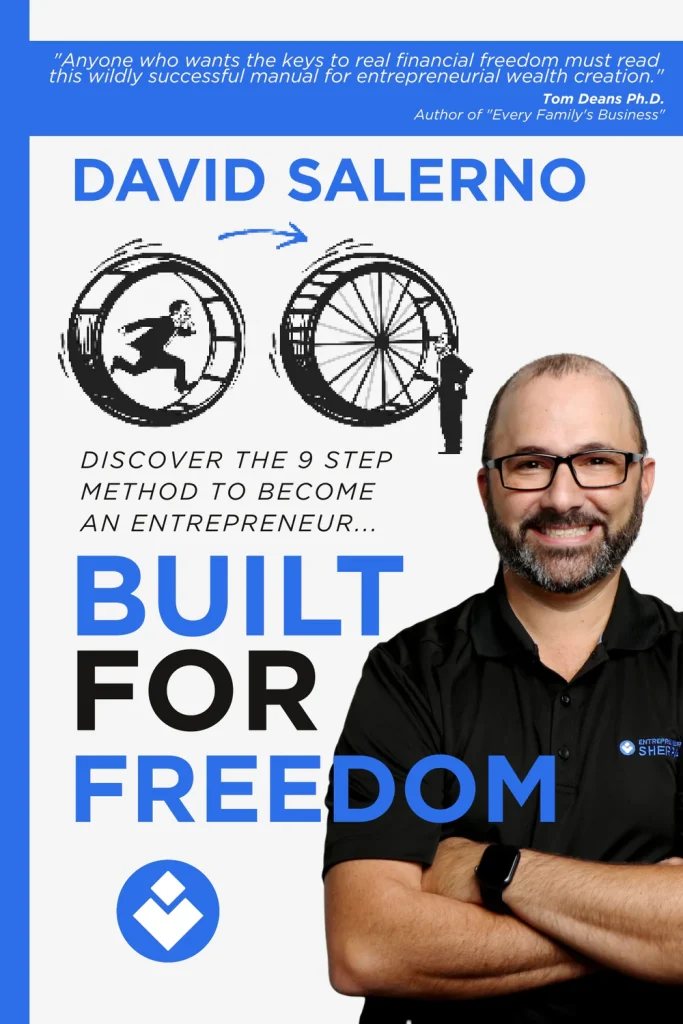
David Salerno is the founder of Entrepreneur Sherpa and the author of Built for Freedom, a step-by-step guide for founders who want to build a company that grows without depending entirely on them to function.
Book: davidsalerno.com Website: davidsalerno.com LinkedIn: linkedin.com/in/davidsalerno