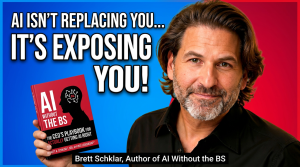

An effective AI adoption strategy, according to enterprise futurist Brett Schklar, starts small and stays intentional. He asks every person in an organization to find one easy task each week that AI can make less painful, while leaders keep asking what the AI they already pay for genuinely returns to the business. Brett has put that return question to more than 1,800 CEOs and business leaders over the past two years, and in Episode 106 of DissedMedia: A Startup Story he joined Ben Olmos to walk through the framework he built from those conversations. He calls it the power of the 1%, and it comes paired with a view that may unsettle some managers, namely that AI can expose weak leadership as readily as it elevates strong leadership.
Most leaders have heard that AI is changing everything, and many have already run a pilot or two. Relatively few, it seems, have stopped long enough to ask what those pilots actually returned; however, that accounting question is the one Brett believes most boards may have avoided. His argument centers upon a simple observation. The companies seeing a real return are seldom the ones throwing AI at everything at once, since the ones that succeed tend to take a slow and deliberate approach that places AI where it is needed and leaves it out where it is not.
From Agency Founder to an AI-Run Business

Brett describes himself, with some humor, as a serial entrepreneur. By his definition, that means a long list of failures punctuated by the occasional accidental success. He spent his early career on the go-to-market side of B2B technology companies before founding the marketing agency Market Creation Group in 2005, which he scaled and eventually sold to a private equity firm in 2019. The journey taught him a great deal. It also left him with a list of things that had kept him awake at night, the kind of lessons that prompt a founder to wonder what he would do differently if given the chance to start over.
His next venture, Grow Powered, connects fractional CMOs with emerging technology companies. Around 2021, as he was beginning to grow it, he had what he calls his ChatGPT moment. Rather than following the typical agency path of hiring heavily and absorbing the overhead that comes with a people-intensive model, he chose to run much of the business on AI and agentic models. The interest from other executives surprised him. Before long he was spending roughly half his time talking with CEOs about why his approach seemed to be working while so many other AI implementations, particularly in the enterprise, appeared to be falling short.
Agentic AI and the Two Ways Leaders Interact With It
Ben raised a point many listeners may recognize. AI has seemingly become a catch-all word, much as everything became cyber in the 1980s and 1990s, or big data a decade or so later. Brett agreed that the industry has lived through several of these buzzword eras; however, he believes this one differs in an important way, because in 2023 AI moved from something used mostly by large companies, universities, research institutions, and government programs to something sitting at the fingertips of every business owner. In his conversations, that shift has produced a world of haves and have-nots. The companies finding ways large or small to embed AI into their operations are beginning to pull away from those that have not.
For leaders still sorting out the vocabulary, Brett explains that there are essentially two ways to interact with AI. The first is the chat experience, an ongoing exchange of questions and answers that resembles an extended search session. The second is the agentic experience, in which AI performs work on your behalf automatically. Agentic work can be as simple as a weekly report that highlights what has changed, or as intense as running financial analyses and recommending to an entire team what it should focus upon next week. Brett believes only a small number of companies should hand over the reins at that level. Most leaders, in his view, will get more value from modest uses such as having AI review the morning inbox or flag which meetings on the calendar truly require preparation.
The Power of the 1% as an AI Adoption Strategy
At the heart of Brett’s AI adoption strategy is a way of sorting work by difficulty and matching a cadence to each level. Each week, he asks people to pick one easy task that is tedious and repetitive, such as running the same report or repeating the same research, and use AI to shorten it or remove it. He calls this the power of the 1%. By his estimate, a person who makes one of these small improvements every week for a year can become roughly 68% more effective, and the individual or leader gets to decide whether that shows up as less work or as more output.
Once a month, the focus can shift to medium tasks. These are process changes or customer pain points where embedding AI might produce something closer to a 5% improvement. Once a quarter, he encourages teams to take on one large and stubborn problem they have repeatedly been told cannot be solved, to see whether rethinking it with AI makes it possible or even practical. Brett notes that this cadence fits naturally with operating models such as EOS, the Entrepreneurial Operating System used by many manufacturing and operations companies. Its greater value, he suggests, may lie in how much of the fear and intimidation around AI it removes.
He recently ran a workshop for the leadership team of a 400-person manufacturing company. Afterward, the CEO asked him to return to work specifically with the operations team, since roughly 80% of the company’s costs sit there and even small percentage gains can carry an outsized effect on the business. The executives who bring Brett in, he says, generally want to know how AI can help their people without replacing them. His view is that AI is far more likely to replace or shorten tasks than whole roles, and that the larger opportunity centers upon bringing more intelligence into decisions so teams can act more cost-effectively. The CEOs he works with want a genuine return on their AI investment, and they seem to have lost patience with science fair projects built mainly to look innovative.
Intelligence, Judgment, and the Leaders AI Exposes
One of the more provocative parts of the conversation focuses upon how AI has changed the value of intelligence itself. Brett argues that businesses of every size now have access to a nearly unlimited supply of intelligence, billed by the month or by the token at fractions of a cent. That may level the playing field in ways that once required expensive consultants or unusually high IQ hires. If intelligence is easy to acquire, he reasons, the human contribution shifts toward judgment and wisdom, along with the emotional intelligence and skill needed to ask questions that draw the best answers out of these systems.
Ben connected this to a distinction he teaches in his business strategy courses. Tactical thinking lives in the day-to-day and quarter-to-quarter work of management, while strategic thinking looks further down the road and is generally what senior leaders are paid for. As AI absorbs more of the tactical gathering and monitoring, people may be pushed toward strategy faster than they expected, which raises an uncomfortable question about how good they actually are at it. Brett answered with a slide he says angers about half of every audience he shows it to. It reads that AI exposes great leaders and it exposes bad leaders.
Strong leaders, in his experience, recognize both the power of their people and the power of AI, and they often seek out the people on their teams who already know how to apply it. In his book he calls this group Generation AI, a cohort defined by how its members think about using AI to solve real problems, with age and education playing little role in who belongs to it. Managers whose value rests primarily upon task and project oversight, however, often feel threatened. Brett believes those managers may struggle, and may take their teams down with them, if they resist instead of helping their people see what AI can do for them. Ben added his own comparison to Blockbuster, a company he believes misunderstood its own business; it saw itself as an entertainment retailer when it was really a content distribution platform, and it read the signals from Napster and early streaming too late to respond.
Where IT Fits in a Company’s AI Adoption Strategy
Brett holds a position he admits may irritate some technology professionals. He believes handing ownership of AI strategy to the IT department is likely to guarantee failure. His reasoning comes from a deep respect for IT, since he grew up in that world and counts many IT professionals among his closest friends. The core job of IT is to keep the organization safe by mitigating risk, and AI carries real risk that calls for guardrails, standard operating procedures, an acceptable use policy, and IT’s direct involvement. Because the department’s instinct is to restrict, an AI adoption strategy led by IT alone may focus upon what people cannot do, which can stall adoption before it has a chance to deliver value.
His recommended structure is a center of excellence or steering committee of five or six people drawn from different levels of the company. IT sits at that table as one important voice. He also suggests a shared channel in Slack or Teams where people can show and tell what AI adoption looks like in their own work. After one recent workshop with roughly 35 leaders from a single company, the CEO told Brett at the team dinner that his two IT representatives had come to him afterward with a confession; they had been about to launch AI in a way that would have guaranteed failure, and they now saw the steering committee as the better path. For Brett, the conclusion fits in a sentence. AI is a business strategy, and it belongs to the business.
Companies with tightly locked down infrastructure can still start somewhere. Brett suggests beginning with whatever tool is easiest for people to adopt, such as Copilot inside a Microsoft 365 environment or Gemini inside Google Workspace, since even a limited tool can help people get past their initial fear and begin experimenting with agents before the organization expands beyond it. He has also seen something surprising inside a 250-person marketing department at a $3 billion software company, where many people remained reluctant to admit they were using AI at all. That reluctance, he believes, may give small and mid-sized businesses an opening to outpace larger competitors that are still working out where AI fits.
Pushing Vendors and Partners to Pass Along AI Efficiencies
One idea tends to produce an aha moment for the CEOs Brett works with. A company can leave much of the AI work to the software it already uses, since its ERP and CRM platforms should increasingly be leveraging AI on its behalf, and leaders can press those vendors to do more of that work. The same logic applies to professional service providers such as attorneys, accountants, marketing agencies, and consultants, many of whom have become considerably more efficient with AI. Attorneys may need to move away from the almighty billable hour. Any company that has not reviewed its marketing agency relationship in the last three years, Brett suggests, may find that the agency could be charging less while still earning healthier margins than before.
Ben compared the moment to the Professor on Gilligan’s Island, the character everyone waited on for answers, noting that everyone now carries a version of the Professor in their pocket. He cautioned, however, that AI will gleefully lead a user in the wrong direction if that person lacks the expertise to recognize a poor answer. Brett added that AI tends to tell people what they want to hear. Both agreed that skilled experts remain necessary to evaluate the output, and Brett emphasized that humans should stay in the loop for the foreseeable future, pointing to the growing volume of low-quality AI content as evidence of what happens when teams use AI mainly to produce more, and suggesting that its better use is work that is more targeted and intentional.
Practice, Organizational Change, and the New Golf Club
Ben shared an analogy from one of his recent classes. Sports supplements and drinks can help an athlete perform, yet they cannot replace the training and practice an athlete still has to put in on the field, and AI seemingly works the same way as an augmentation to work a person still has to do. Brett connected this to a lesson from his own organizational behavior coursework. A golfer who buys a new oversized driver may hit one great shot before his game gets worse, because he now has to relearn how to swing. Organizations, in Brett’s view, are at that stage with AI right now, and he believes the gains from any AI adoption strategy come from repeated practice with the new tool.

Ben closed the conversation by noting that children three years old and younger today will never know a world without AI. Leaders who understand and leverage these tools, he suggested, may be far better positioned to prepare that next generation for the work ahead of them. Research such as McKinsey’s ongoing State of AI survey can offer useful context on how organizations are adopting AI more broadly, while Brett’s framework is built for the leader who wants a practical starting point this week.
AI Without the BS and How to Connect With Brett Schklar
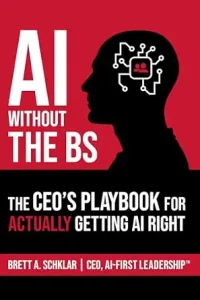
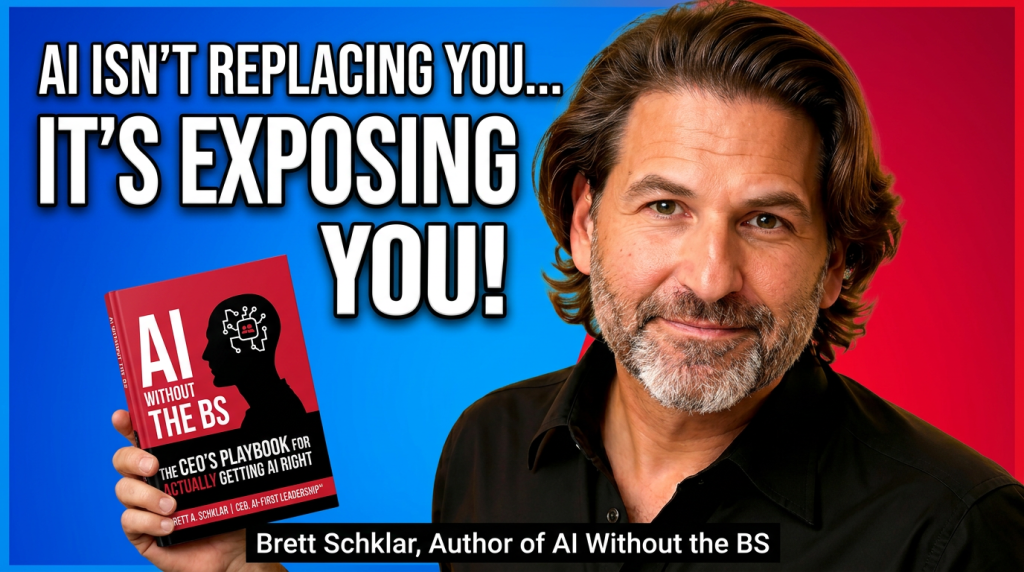
Brett’s book, AI Without the BS: The CEO’s Playbook for Actually Getting AI Right, expands on the ideas from this conversation, including the Generation AI chapter and his case for treating AI as a business strategy owned by the business. He notes that he is the only Brett Schklar on LinkedIn, which makes him easy to find there. His current projects are listed at brettschklar.com, and he publishes regularly on Substack. Leaders who want to talk through their own AI adoption strategy can reach him directly at brett@aifirstleadership.com.
Frequently Asked Questions
What is a good AI adoption strategy for a small or mid-sized business?
Brett Schklar recommends starting with small, intentional wins. Each person uses AI to improve one easy and repetitive task every week, and the team builds toward larger monthly and quarterly efforts on the harder problems it has long put off. He believes this approach can lower the fear many employees feel about AI while producing returns leaders can actually measure.
Will AI take my job?
Across more than 1,800 conversations with CEOs and business leaders, Brett has found that AI is far more likely to change and shorten the tasks inside a job than to eliminate the job itself, although he acknowledges a few exceptions. The people he sees struggling most tend to be those who resist the change. Those who use AI to remove tedious work often find themselves with more time for higher-value projects.
Should the IT department own a company’s AI strategy?
Brett advises against it. IT’s core responsibility is to mitigate risk, so an AI strategy led by IT alone may focus mainly upon restrictions. He suggests a cross-functional steering committee or center of excellence of five or six people from different levels of the company, with IT included as one of several voices.
How do you measure the ROI of AI in a business?
Brett encourages leaders to ask what the AI they already pay for genuinely returns, measured in time saved and steps removed along with the quality of decisions. He also suggests pushing software vendors and service providers to pass their AI efficiencies along through better products or lower fees.
For more conversations on AI in the workplace, see our episode with Rob Broadhead on fixing business processes before AI exposes them, our founder panel on managers using AI and employee trust, our conversation with Chris Hallberg explaining EOS and the Entrepreneurial Operating System, and Matt Rouse on whether AI will take your job.
Episode 106 is available now wherever you listen to podcasts. Watch the full conversation on the DissedMedia YouTube channel at @DissedMedia and subscribe to help us reach 100,000 subscribers by the end of 2026.