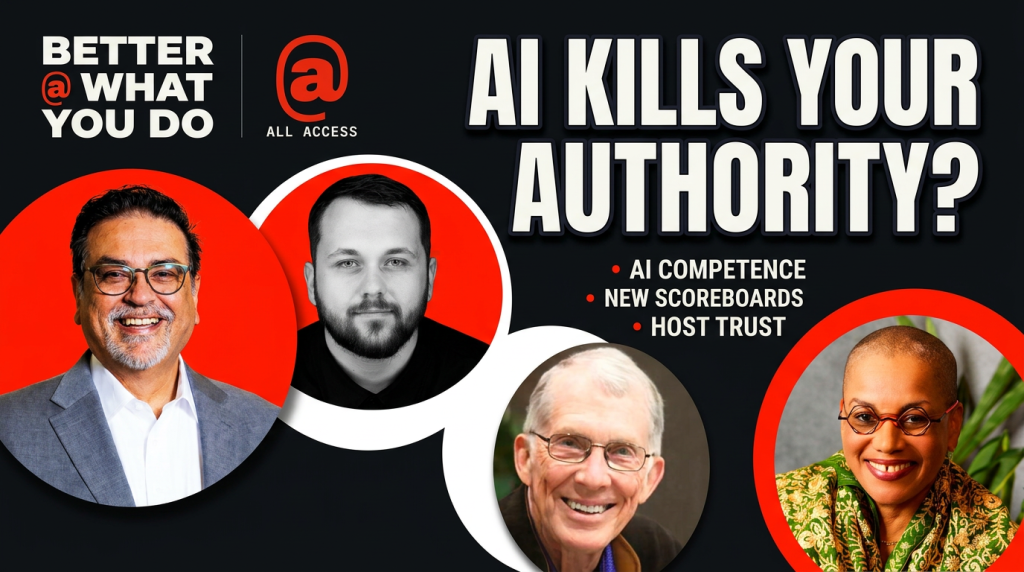

Managers using AI may be earning less credit for it than they expect, at least according to a recent Omni Calculator survey in which 40% of employees said those managers come across as less competent and 36% said they trust their judgment less, with Gen Z respondents offering the harshest assessment of any group. The finding arrives at a moment when AI is working its way into nearly every corner of the organization, which leaves leaders and owners with a fairly uncomfortable question about what the people around them conclude when they see the tool at work.
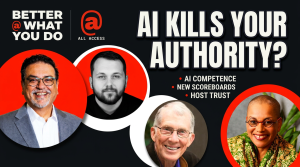
Host Ben Olmos put that question to a panel on Better at What You Do, bringing back three former guests of DissedMedia: A Startup Story: Stephanie Sylvestre, CEO of Avatar Buddy; Rich Ashton, owner of Growing Your Own; and Joshua Griffin, co-founder of Intrinzi. Their conversation moves from where AI belongs inside a business to the sameness creeping across LinkedIn and the way YouTube now counts a view, and it eventually works toward a broader theme, which is what remains worth measuring once somebody else holds the scorecard.
Managers Using AI and the Line Between Lazy and Useful

Stephanie, who hires Gen Z interns every summer, has heard versions of this skepticism firsthand; one candidate told her in an interview that they did not like AI and had applied only because a teacher advised learning it and because her company seemed to be using it for good. She found that refreshing, and she described interns researching agentic AI who came back recommending against a project because it could violate other companies’ terms of agreement, which is the kind of pushback she believes a leader should want to hear.
Her own standard separates what she calls lazy AI, such as letting an assistant built into an office suite write every email without a second thought, from AI that gets real work done, and she offered the example of a customer whose spreadsheet ran from column A to column FD being analyzed by an agent in about six minutes while a person still checked the results and made the final call. Time saved that way, she argued, can go toward the half minute it takes to write a team member a sincere note of thanks, a task she sees no reason to hand to a machine. Ben added an example from his own work in the wine industry, where roughly two decades of pricing history kept in spreadsheets was pulled into a single database table with help from an AI model, a use that few employees would seemingly object to.
Communication as a Leader’s Most Powerful Tool

Rich, who spent 45 years owning and operating small businesses, believes the best communicators tend to be the best leaders, and that a manager who hands communication over to AI may be giving up some leadership capability in the process. Most people can recognize it, he noted, particularly when a manager who has never communicated well suddenly sends an email full of flowery, sophisticated language. His companies do use AI to streamline back office operations, where it has made the work more efficient and often more accurate; however, he keeps it out of customer-facing roles because, in his view, it is not yet as good as his people, and a customer service organization would be unwise to trade that away to save a few dollars.
Ben summarized the pattern with a restaurant comparison, suggesting that people appear comfortable with AI so long as it stays behind the kitchen door and grow uneasy once it walks into the dining room. Stephanie applied the same thinking to the hardest conversations a leader has, arguing that a layoff delivered by an AI-written email reflects a failure of leadership, since the person making that decision should expect to lose some sleep over it and should deliver the news face to face, or by video when the team is remote.
Humans Still Buy From Humans

Joshua described his own relationship with AI as equal parts love and hate, comparing his early use to a first car that he drove everywhere, including to places that were a five-minute walk away. When Intrinzi began to scale he leaned into automated cold outreach along with most of the industry, and then found that picking up the phone and speaking with prospects as one person to another produced the agency’s best results. He still relies on AI heavily for data work, which he happily admits is far from his strength, while he and his business partner spot-check what comes back and stop short of granting any tool full control over their systems.
Ben offered a cautionary tale on that last point, recalling the day he asked an AI model to free up space on his computer and watched it delete his entire Windows installation, a loss he recovered from only because he keeps backups of his backups.
LinkedIn Sameness and the Return of the Handshake
When the conversation turned to social media, Rich asked whether AI has compromised LinkedIn, observing that he often feels as though he is reading the same post from fifteen different people. Joshua, whose background is in SEO, believes the platform’s algorithm now tends to favor a personal tone, and he mentioned that LinkedIn has added a way for users to flag posts as AI slop, which suggests the company recognizes the problem. Stephanie treats her profiles mostly as reference notes, a digital footprint that lets someone she has met confirm she is a real person with a consistent story.
She also made the case that the flood of generated content may be pushing business back toward human contact, which she welcomes. Her team once aimed to reach 7,000 people a month and now reaches closer to 150, each of whom gets a real conversation, and she would sooner spend a marketing budget on a plane ticket to meet people in a new city than on another round of ads. Joshua has seen the same effect in his agency, where a physical office and a willingness to drive across the country to buy a prospect a coffee have won clients, and he expects being human to stand out even more as others automate. Stephanie does use AI at the top of her sales funnel to sort through the many prospects who will say no, so that her people can spend their time with the few who say yes.
YouTube View Counts and the Vanity Metric Problem
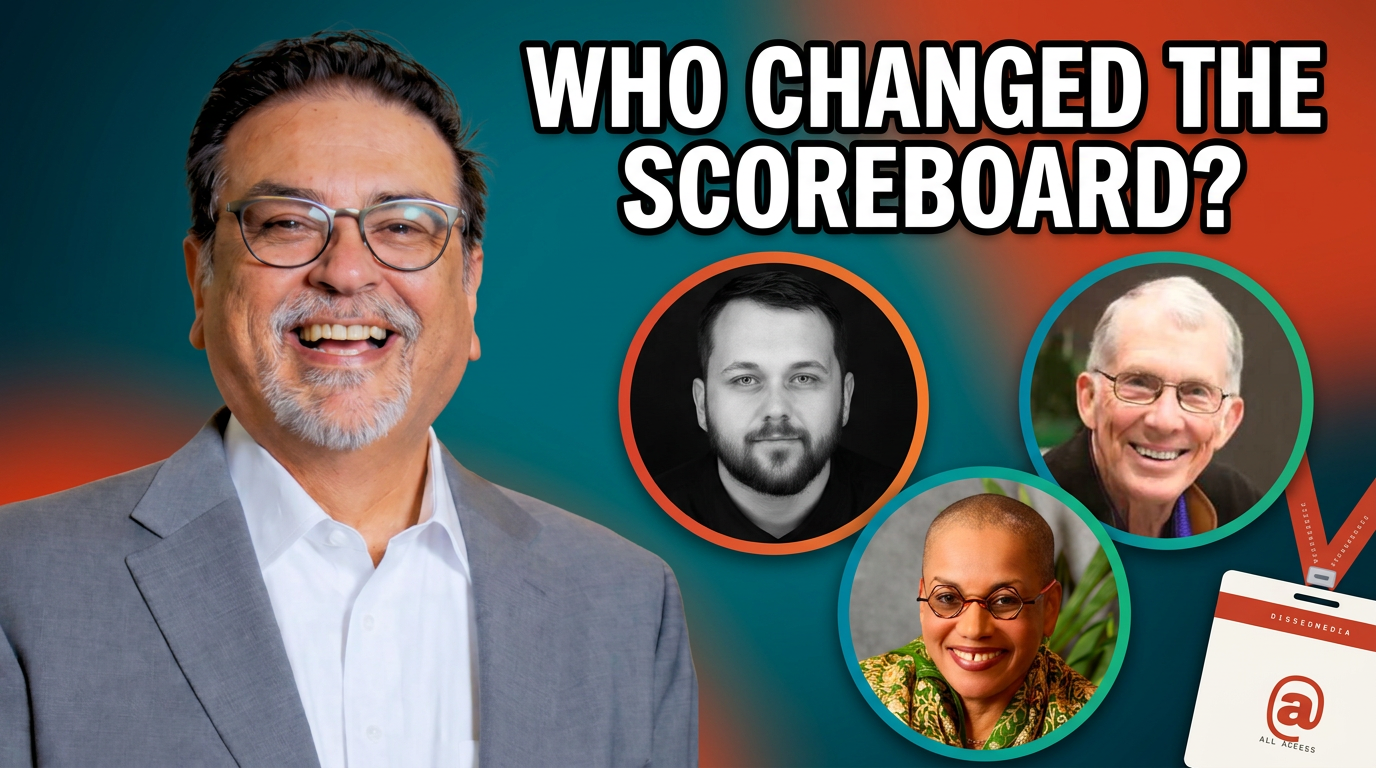
Ben then raised recent changes at YouTube, which by his account has raised the bar creators must clear for monetization while counting a view much earlier than before, leaving the more meaningful engagement figures inside YouTube Studio where the public cannot see them. For a host who builds social proof around subscribers and views, that shift may make the public numbers larger and less informative at the same time. Joshua, who has been testing short clips of six to ten seconds, suspects the platforms are trying to separate committed creators from the volume of AI-assisted content now being sliced up and reposted.
Stephanie drew the distinction between vanity metrics and quality metrics, asking what a view count is worth if it never produces a sale, and Joshua agreed that a LinkedIn post with two comments can be the one that brings in revenue. She also noted an upside, which is that inexpensive AI video has opened the door to creators, many of them young people in the Global South, who could never have paid $1,500 for a single produced video.
Host, Guest, or Topic: What Draws a Podcast Audience
The final topic centered upon a study Ben cited in which 82% of listeners said the host is a major reason they tune in to a favorite podcast. Rich was not fully persuaded; in his experience, heavily scripted shows and shows where the host mostly talks about himself are hard to sit through, while conversational shows work because of whom the host chooses to bring on and how they interact. Joshua suggested the answer may depend on genre, since he follows comedy podcasts for the host and business podcasts for the guest.
Stephanie explained how she decides which invitations to accept, a discipline she traced back to serving as honorary consul of Belize in Miami at 27, when she learned to say yes only where there was genuine chemistry. The discussion then took an unplanned turn when Ben and Joshua compared audience demographics that skew male, and Stephanie, the only woman on the panel, spoke candidly about a period in her career when there seemed to be room for only one woman at the table and how that scarcity shaped the way women supported one another. Ben closed with the principle he repeats to his HR students, that decisions about who gets hired or promoted should rest on the knowledge, skills, and abilities a person brings to the job.
Frequently Asked Questions
These are the questions people ask most often about managers using AI and the panel that discussed it.
Do employees trust managers who use AI?
A recent Omni Calculator survey discussed on the episode found that 40% of employees see managers who use AI as less competent and 36% trust their judgment less, with Gen Z the most critical. The panel’s view was that the reaction depends heavily on where the AI shows up, with personal communication drawing far more skepticism than back office work.
Where should managers use AI in a small business?
The panelists use it for data analysis, back office operations, research, and sorting early-stage sales leads, with a person checking the output. They keep it away from customer-facing service and from personal messages such as recognition or difficult news.
What is Better at What You Do?
Better at What You Do is a DissedMedia panel podcast hosted by Ben Olmos, where managers, leaders, and entrepreneurs work through the stories shaping how they run their business.
How can I reach the panelists?
Stephanie Sylvestre is at avatarbuddy.ai and on LinkedIn. Rich Ashton is at growingyourown.net, and Joshua Griffin is at intrinzi.com and joshgriffin.co.uk.
The full panel covers more ground than a single article can hold, including Stephanie’s Caribbean tradition of liming and Joshua’s admission that he almost never clicks subscribe. The full episode on managers using AI is below; you can find Stephanie Sylvestre at avatarbuddy.ai, Rich Ashton at growingyourown.net, and Joshua Griffin at intrinzi.com.
More at dissedmedia.com, rostr.studio, and benolmos.com.