


Most time management advice is written for individual contributors who control their own schedule. Leaders do not. A significant portion of a manager time is legitimately not their own: it belongs to the people they lead, the decisions that require their input, and the coordination that only they can do. Treating that as wasted time and trying to eliminate it is the wrong diagnosis. The real question is how to structure the time that is discretionary so it goes toward the highest-leverage work rather than whatever arrived most recently in the inbox.
This guide covers what research shows about how leaders actually spend time, what distinguishes high-effectiveness time allocation from low-effectiveness, and the practices that make the biggest difference.
Time management is a critical skill in both personal and professional settings. As the pace of life accelerates and demands multiply, mastering the art of managing time effectively becomes increasingly important. By examining some of the latest research from the fields of psychology and business, you can discover practical strategies for combating procrastination and improving your time management skills. One effective tool is the Eisenhower Matrix, which helps prioritize tasks based on their urgency and importance. By understanding the psychological underpinnings and business practices, you can enhance your productivity and improve your well-being.
Understanding Time Management
Time management involves planning and exercising conscious control over the amount of time spent on specific activities. This skill enables individuals to improve efficiency, effectiveness, and productivity. The concept has evolved significantly over the years, integrating insights from various disciplines, including psychology and business.

Psychological Insights on Time Management
The Role of Self-Regulation
Self-regulation refers to the ability to control one’s emotions, thoughts, and behaviors in the face of temptations and impulses. Research indicates that self-regulation is crucial for effective time management. According to Baumeister and Vohs (2016), self-regulation can be seen as a muscle that can be strengthened with practice. Techniques such as mindfulness and setting specific goals can enhance self-regulation, thereby improving time management.
Procrastination and Its Effects
Combating procrastination is a common challenge for effective time management. Steel (2007) defines procrastination as the voluntary delay of an intended course of action despite expecting to be worse off for the delay. Psychological research suggests that procrastination is often linked to fear of failure, perfectionism, and a lack of intrinsic motivation. Strategies to combat procrastination include breaking tasks into smaller, manageable parts and using positive reinforcement to create a sense of accomplishment.
The Impact of Stress and Burnout
Chronic stress and burnout can severely impact time management. According to Selye’s (1974) General Adaptation Syndrome, prolonged stress can lead to exhaustion and decreased productivity. Implementing stress management techniques such as regular physical activity, adequate sleep, and relaxation exercises can mitigate these effects and enhance time management capabilities.
Business Strategies for Effective Time Management
Goal Setting and Prioritization
Effective time management in business often starts with clear goal setting and prioritization. Locke and Latham’s (2002) Goal Setting Theory emphasizes the importance of setting specific, challenging goals and receiving feedback on progress. By prioritizing tasks based on their urgency and importance, individuals can focus their efforts on what truly matters.
The Eisenhower Matrix
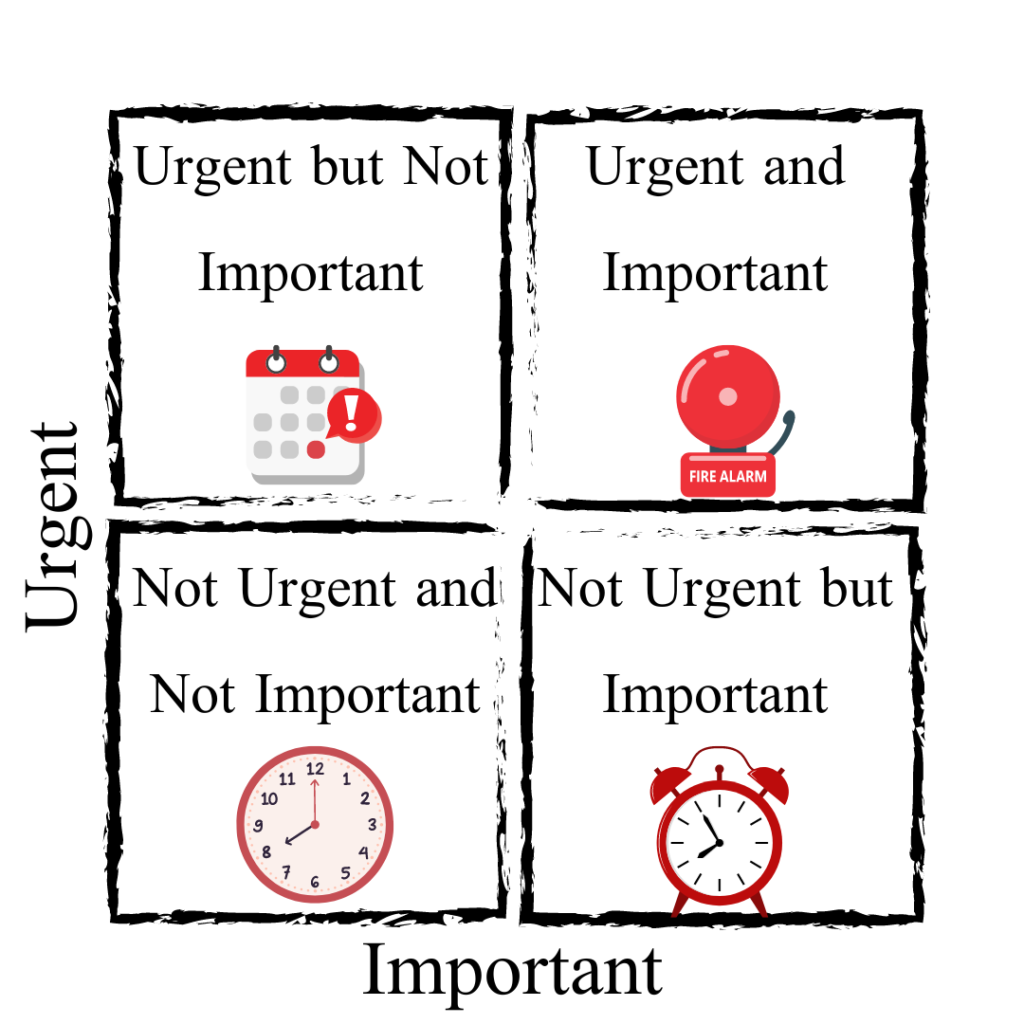
The Eisenhower Matrix, also known as the Urgent-Important Matrix, is a tool that helps prioritize tasks by urgency and importance. This matrix categorizes tasks into four quadrants:
- Urgent and Important: Tasks that require immediate attention.
- Not Urgent but Important: Tasks that are important but can be scheduled.
- Urgent but Not Important: Tasks that are urgent but not critical.
- Not Urgent and Not Important: Tasks that can be minimized or eliminated.
Using this matrix can help individuals focus on tasks that contribute to long-term goals while managing immediate demands.
Time Blocking and Scheduling
Time blocking is a technique where specific blocks of time are allocated for particular tasks or activities. This method, endorsed by business leaders like Elon Musk and Bill Gates, involves dividing the day into segments dedicated to specific tasks, thereby minimizing distractions and improving focus. Tools such as digital calendars and project management software can facilitate effective time blocking.
Integrating Psychology and Business Practices
Combining psychological insights with business strategies offers a holistic approach to time management. Here are some integrated strategies:
Mindfulness and Time Blocking
Incorporating mindfulness into time blocking can enhance focus and reduce stress. Mindfulness practices, such as deep breathing and meditation, can be scheduled into daily routines, providing mental clarity and improving the ability to manage time effectively.
SMART Goals and the Eisenhower Matrix
Setting SMART (Specific, Measurable, Achievable, Relevant, Time-bound) goals and using the Eisenhower Matrix can streamline task prioritization. This combined approach ensures that tasks are aligned with long-term objectives while managing immediate responsibilities.
Regular Reflection and Adjustment
Regular reflection on time management practices allows for continuous improvement. Techniques such as journaling and self-assessment can help identify areas of inefficiency and adjust strategies accordingly. This reflective practice aligns with the concept of self-regulation and promotes sustained time management improvements.
Effective time management is a multifaceted skill that integrates psychological principles and business practices. By understanding the role of self-regulation, combating procrastination, managing stress, setting clear goals, and prioritizing tasks, individuals can enhance their productivity and well-being. Embracing a holistic approach that combines insights from psychology and business ensures a balanced and effective time management strategy.