
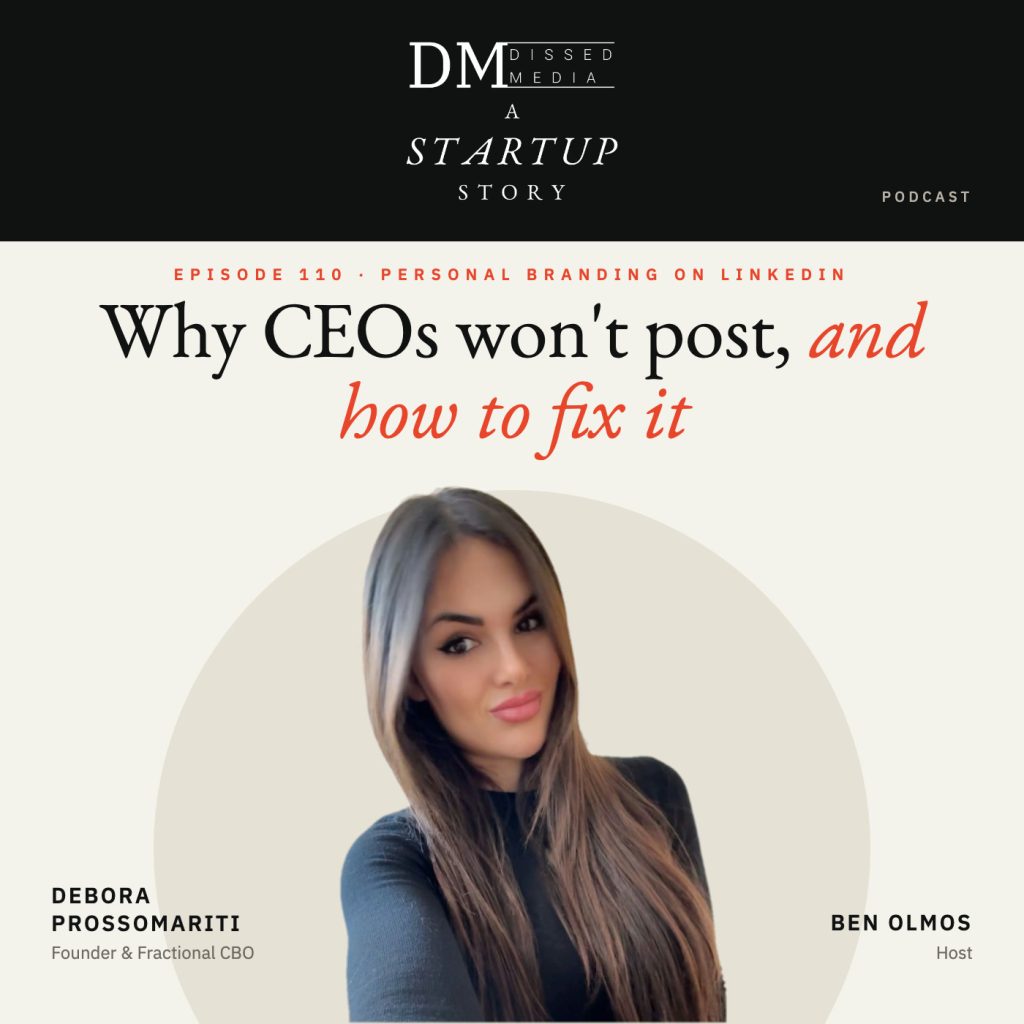
Executive personal branding can seem, to a CEO who has spent years earning authority inside an organization, like an uncomfortable detour into self-promotion, and the instinct to sound polished and corporate on LinkedIn may be the very thing that keeps a leader’s content from reaching the people it was meant for. Debora Prossomariti has built a business around closing that gap. As founder of Personal Branding Atelier and a Fractional Chief Brand Officer to CEOs, she works with leaders and their teams on how the person at the top of a company shows up in public, and in Episode 110 of DissedMedia: A Startup Story she joined Ben Olmos from her base in Dubai to trace the path that took her from a job search to advising executives, along with her view that credibility is best earned long before anyone needs to ask for something.
From Corporate Finance to a Personal Brand Built in Her Third Language
Debora’s first degree was in business administration and corporate finance, a background that may seem like an unusual starting point for someone in branding; however, she credits it with letting her speak the same language as the CEOs she works with now, a language she describes as quite different from the one spoken in marketing. She had been doing PR and promotional work on the side since she was 16, so when she moved into a master’s in international management with a major in marketing, it was the psychology behind how people buy and make decisions that held her attention, and that interest is what eventually led her toward social media. During that degree she started her own job search, and in the process she became good at networking and positioning herself on LinkedIn, learning how to reach the right people with the right message and how content could attract those people on its own.
Credibility was hard won. As a young woman advising people considerably older than herself, and doing so in her third language, she says she started from a lower position than most of the executives she now advises, who tend to arrive with a senior title and a track record already in hand. Her focus on inbound content eventually drew attention from Meta, where she went to work first, before moving to Pinterest in Dublin. As her own brand grew, she found that the market was already validating her ideas, so she started a consultancy as a side hustle, and by her account she was in a position to leave her full-time job within roughly four months.
Building an Audience of Senior Executives in Six Months
Ben pointed to something a former DissedMedia collaborator once told him, that audiences take time, and asked how long it really took Debora to build the following that let her leave. Her answer was careful, since she does not want anyone to come away believing in overnight success. The skills, she explained, were built much earlier through her degrees, and during her years at Meta and Pinterest she was already advising business owners on paid social strategy, which gave her a working sense of how different business models sell online to different audiences. When she decided to run her own advisory firm, she applied that knowledge to herself, treating her own profile as a living test, and within the first six months she gained roughly 24,000 followers, most of them senior executives in the United States, even though she was living elsewhere at the time. Her takeaway was that information seldom moves anything until someone puts it into practice.
Aligning the Message With the Result You Expect
Asked what she saw in ad campaigns that others tended to overlook, Debora returned to a mismatch she still encounters often, in which the message a business sends has little to do with the result it is measuring. A company that shares mostly educational content while expecting that content to produce sales may be disappointed for reasons that have nothing to do with the quality of the posts, and she encourages leaders to test what works for their own situation instead of copying a strategy someone else swears by, since frameworks may transfer while the conditions of each business seldom do. Something that performs well in the United States, she noted, may land very differently in Italy.
That thinking shapes how she approaches her work today. She specializes in leaders and their teams, helping them carry out the global brand strategy on the leadership side, because she believes a founder who serves as the face of the company needs to be believable first; people tend to buy from people, and when there is a disconnect between what a founder says and what the company does, it can become a real problem. She also works with companies directly through master classes and corporate training sessions, and while she has offered products in the past, her current focus centers upon services, with new products in development along the same lines.
How Executive Personal Branding Changes Across Cultures
Debora speaks five languages and has lived in ten countries, which she considers something of a competitive advantage when helping leaders whose companies operate globally. Although she is from Europe, she runs her company out of Dubai, and most of her audience comes from the United States, the United Kingdom, Canada, and Australia, with a smaller share in Dubai itself. Her approach to executive personal branding across those markets begins with validating before assuming anything, and with staying open-minded enough to accept that a message which misses may reflect the audience’s context more than any failing on the part of the person who sent it.
Time itself, she pointed out, can be a useful illustration. A 9 a.m. meeting in northern Italy might start a few minutes after nine without anyone considering it late, while in Brazil or Greece some people may arrive an hour or two later because the social expectations are simply different, and when she moved to Portugal she initially found the slower pace disrespectful before coming to see it as a reflection of how people there choose to live. Ben recalled similar experiences working in Italy, where meetings often begin with greetings and questions about family well before anyone turns to business, and both agreed that leaders working across borders may need to set aside some of their own habits to understand what a message will mean on the other side.
The CEO Ego and the Pressure to Sound Smart
When Ben asked about the challenges of helping leaders find and use their own voices, Debora named managing the CEO ego as one of the most common. Part of the resistance, she explained, may be a response to the unknown, since the brain tends to favor safety over growth, and a leader who is suddenly more visible often starts pushing back or trying hard to sound smart, which makes the content more performative than it needs to be. LinkedIn has changed a great deal over the past few years, she added, yet many executives still believe a senior title requires them to sound serious and professional at all times, with no room for a joke or a human moment. That instinct has become even more noticeable now that so much content is written with AI and reads as uniformly polished and corporate, and she believes posts that sound like the way a leader actually writes and thinks tend to perform better.
Ben offered the counterpoint that the higher someone sits in a large company, the more there is at risk, and since humor translates unevenly, many leaders reasonably choose to keep their guard up. Debora agreed that the caution is understandable, which is part of why her role exists; she describes herself as acting partly as a reputational shield, drawing on corporate governance and social listening to anticipate how something may be perceived. She pointed to a recent case in which a leader posted about underpaying his contractors, apparently forgetting that the people he hoped to hire could read it, and found that nobody wanted to work with him afterward. Her advice is to rely on critical thinking over whatever an AI tool suggests, since AI can be overconfident and may miss the context of a situation, and to lean on a marketing team or advisor who can reflect how a post might come across to staff and other stakeholders. Being intentional and strategic, in her view, still leaves plenty of room for a leader to show up as themselves; it simply means exercising some control over what gets said in public.
The Fear Underneath “I Don’t Have Time”
Ben described a familiar objection from people he encourages to podcast or post, many of whom see content as a chore and assume TikTok means dance videos, and he asked how Debora gets leaders comfortable with putting their work in front of people across several platforms. She starts with the assumptions and limiting beliefs underneath the objection, because she has found that statements about having no time or being bad at marketing often cover a fear of being visible and judged; executives, after all, manage to build successful businesses while busy, so they tend to make time for what matters to them. Where a leader genuinely does not know how to do the work, she believes a system and a strategy can remove most of the overthinking.
One question she asks clients is whether they read books or watch TED Talks, and whether they think of those authors and speakers as influencers or as people they admire and learn from. Shifting the focus from oneself to the message, she explained, changes how the work feels, and it can help with public speaking as well, since a leader who asks what lesson from last week might help someone with fewer resources is far less likely to freeze over a single post. What keeps her going on difficult days is a reluctance to let the loudest voices dominate the conversation; if the only stories people see glamorize companies that raise outside money, for example, those who want to bootstrap may never realize they have a choice, and she believes a wider range of perspectives gives people more than one definition of success. Readers interested in the content side of this may find the earlier conversation on thought leadership tips with Kelly Schuknecht a useful companion, along with the site’s broader guide to what thought leadership is and how to build it.
Asked whether some clients simply are not ready, she said that because she works mainly through inbound inquiries, prospects usually tell her where they stand, and she holds that readiness is a decision more than a feeling, since a few more conversations often bring someone around to wanting to do the work.
Network Quality and Volume on LinkedIn
Ben recalled a recent guest, a long-time LinkedIn expert, who argued that fewer and higher-quality connections serve a person better, an approach covered in the episode on how to network on LinkedIn without cold pitching, and he asked whether Debora adjusts her advice depending on a client’s goals. She does, and she began by challenging the narrative that a person needs to go viral and collect a huge following to make money from the platform, a belief she says is often promoted by people who buy likes to manufacture social proof. Personal branding for business, as she sees it, has little to do with popularity; however, she also believes quality alone falls short, since a conversion rate is still a percentage of whatever traffic a profile and its content generate, and without some volume there are too few chances to start a conversation. Her recommendation is to curate a network carefully while still growing it, and she noted that executives who insist they have no need to be visible are sometimes using that position to avoid exposure.
Organic Reach and Paid Promotion
Ben explained that he promotes DissedMedia videos on YouTube because, like a film or television show, a media company’s work seldom finds an audience without distribution, and only a small share of the people who see something will click and stay. Debora, who worked in advertising at Meta and Pinterest before growing her own presence organically on LinkedIn, sees skipping organic content as a missed opportunity, since the platform costs nothing beyond time, and what performs well organically can then be tested in paid campaigns with a good chance of working. For a personal LinkedIn account, however, she generally advises against promoting posts, since in her experience the organic reach remains strong; it has declined since the COVID era, she acknowledged, though she still receives millions of impressions a year. LinkedIn advertising also tends to cost more than other platforms, and she knows people running promotions on Facebook and Instagram alongside their organic work with good results, so the decision may come down to whether the return on ad spend justifies it.
She sees employee advocacy as one of the more underused options, where a company offers incentives such as challenges or bonuses for employees to post about the company within its brand guidelines, which can feel more organic because the employee is the one speaking. In her framing, promotion works best as an amplifier for a coherent narrative that already exists, and when there is little organic content behind it, paid reach can come across as hollow once someone lands on a profile and finds nothing there to back it up.
How Often Executives Should Post on LinkedIn
On frequency, Debora’s answer depends on capacity. She has worked with leaders who post confidently once a week and see strong results, though she considers three or four posts a week a better way to use the platform, and she counts engagement in comments and direct messages as part of the effort, since the goal is to start good conversations with the right people and likes mean little if the business goals are going unmet. Content creators chasing brand partnerships may post five or six times a week or even twice a day, while an executive building authority and thought leadership can likely do well with one to four posts a week, and short-form platforms such as Instagram and TikTok tend to reward far more frequent posting than LinkedIn, where a longer written post is often enough.
That consistency may matter to buyers as much as to followers, and research on thought leadership seemingly supports the investment; the 2024 B2B Thought Leadership Impact Report from Edelman and LinkedIn, which surveyed nearly 3,500 management-level professionals across seven countries, examined how thought leadership influences the buying behavior of decision-makers and C-suite executives, and it suggests that well-made content from a company’s leaders can carry real weight when buyers judge what that company is capable of.
Starting Executive Personal Branding Before You Need It
Ben closed with an argument he makes often, that being visible has become part of working life for nearly everyone and that the best time to start is well before a need arises, since nobody wants to scramble to get noticed at the moment they are looking for a job or new clients. Debora framed the idea as deposits and withdrawals, explaining that a person who has been sharing their thinking and leadership for some time shows up with a different energy than someone who appears only when they need something, and that giving first earns the right to ask. When a leader with a well-positioned profile and a body of content behind it makes a request, people have something to evaluate and find it easier to help; an empty profile paired with an ask gives them nothing to go on, which is why she believes continuity matters so much in executive personal branding.

She is also developing a new resource called CEO Brand Architecture, designed to help leaders assess where they stand and identify the gaps between their current positioning and the authority they want to build online, along with the next steps that may close them.
Connect With Debora Prossomariti
Debora is easy to find, as Ben noted on air, since very few people online share her name, and the best place to start is her LinkedIn profile, where she shares insights on building a brand and authority as a leader. The link to CEO Brand Architecture will be added to the episode show notes once it is available.
Frequently Asked Questions
What is executive personal branding?
Executive personal branding is the work of shaping how a CEO or senior leader is perceived in public, usually through the content they share and the point of view they hold consistently over time. Debora Prossomariti approaches it as part of a company’s overall brand strategy, since people often decide whether to trust a company by first deciding whether they trust its leader.
How often should executives post on LinkedIn?
Debora suggests that executives focused on authority and thought leadership can do well posting one to four times a week, with three or four being a stronger target if capacity allows. Engaging in comments and direct messages counts toward that effort, since the goal is starting conversations with the right people.
Should executives pay to promote their LinkedIn posts?
For personal accounts, Debora generally advises against it, since organic reach on LinkedIn remains strong and advertising there tends to cost more than on other platforms. She sees paid promotion as most useful for amplifying organic content that already performs well and fits a coherent narrative.
What does a Fractional Chief Brand Officer do?
A Fractional Chief Brand Officer works with a company’s leadership on a part-time basis to shape and carry out brand strategy on the leadership side. In Debora’s practice that includes advising CEOs and their teams on positioning and public reputation, often acting as a check on how a post may be perceived before it goes live.
Episode 110 is available now wherever you listen to podcasts, and it may be especially useful for any founder or senior leader weighing where to begin with executive personal branding. Watch the full conversation on the DissedMedia YouTube channel at @DissedMedia and subscribe to help us reach 100,000 subscribers by the end of 2026.
More at dissedmedia.com, rostr.studio, dailypitch.news, and benolmos.com.