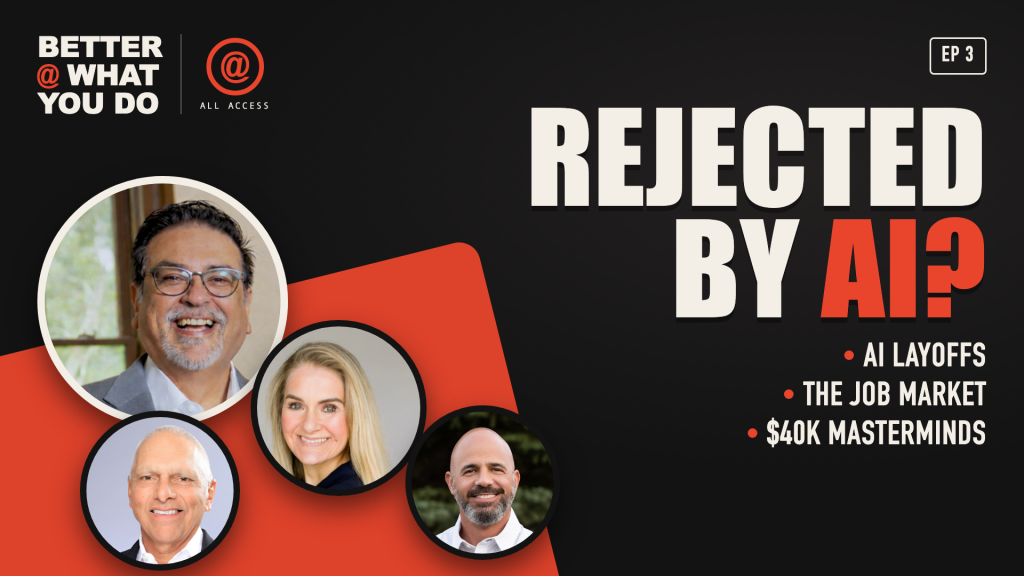

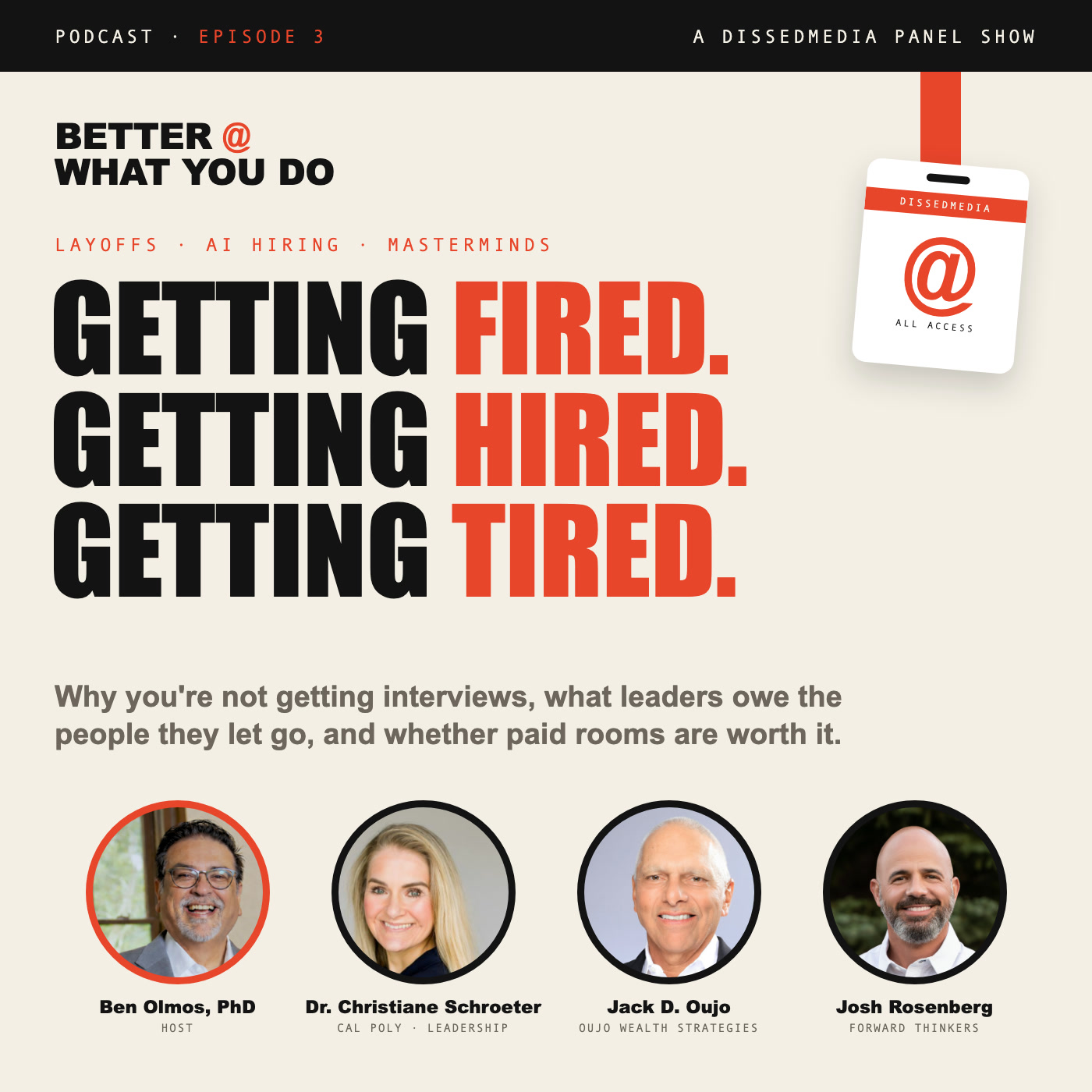
Learning how to find a job in today’s market seemingly comes down to the people who already know your work, since AI screening tools may reject an application before any person reads it, and the most dependable way past that filter tends to be a referral from someone inside the company or a follow-up persistent enough that a hiring manager remembers your name. That was the conclusion a panel of operators kept returning to on the third episode of Better at What You Do, where host Ben Olmos brought back three former guests of DissedMedia: A Startup Story to work through layoffs and the paid networks promising a way back into work, a conversation the episode itself framed as getting fired, getting hired, and getting tired.
The panel included Dr. Christiane Schroeter, a leadership strategist and Cal Poly professor of innovation and entrepreneurship; Jack Oujo, the former professional baseball umpire who founded Oujo Wealth Strategies and wrote Too Smart to Be an Umpire; and Josh Rosenberg, founder of Forward Thinkers and a longtime executive in the beverage industry. Each of them has hired people, and each has spent time on the other side of the table, which may be why their advice on how to find a job sounded far more practical than most of what circulates on LinkedIn.
Disney’s Layoff Comments and What Leaders Owe the People Affected

The episode opened with Disney president Dana Walden, who told an audience at Bloomberg’s Screentime conference in Los Angeles that the company’s latest cuts were extremely painful, arriving the same week that more than 300 employees, most of them in human resources and technology, were let go. Ben’s reading of the clip centered upon the order of the answer, since in his view a leader who spends most of the response on the business rationale and closes with the people affected has the sequence backward, and he argued that the people should come first if a company genuinely means what it says about servant leadership.
Josh, who was asked to relocate six times in six years to keep his job at a global beverage company, pushed back hard on the public reaction. He pointed out that executives who try to sound empathetic get criticized as harshly as those who do not, that companies rarely receive credit for the jobs they add, and that society has grown noticeably cruel toward leaders who speak candidly on a stage. However, his larger point centered upon accountability, which he believes runs closer to 50/50 between employer and employee than most people care to admit; the company owes people a fair exit, while each person owns how well positioned they are when the call comes. Readers who know Josh from his earlier conversation on scaling a business from 129 to 700 employees will recognize the same operator’s instinct here.
Knowing Your Numbers Before a Layoff Arrives

Jack approached the same story from his years in wealth management, where clients between roughly 50 and 65 would arrive having lived under the threat of a layoff for years, uncertain whether they could afford to retire or move into consulting. His advice was to know your numbers well before any announcement, since a person who understands what they need to live on can treat a layoff as a decision point, weighing a consulting role or an equity stake in a private company in place of a salary. He tied that discipline to his own release from professional baseball after eight years in the minor leagues, an ending he says he had prepared for because every athlete knows the career stops someday, a story he told in more depth in his earlier episode on financial independence lessons.
Christiane extended the point from finances to skills. In her experience working with entrepreneurs, people who notice a competitor doing what they do tend to freeze, when the more useful response may be to pick up new skills or seek out others who have recovered from the same position; no job, she argued, stays safe for the rest of anyone’s life, and the habits that carry people through a transition have changed very little across history. Ben added his own observation that the era of the gold watch and the 25-year career was seemingly a brief moment in employment history, and that businesses, which he described as driven by revenue and profitability, will keep restructuring whenever that story changes.
AI Screening and How to Find a Job Through the People You Know
The hiring segment began with research that may explain why so many qualified people feel invisible. A study out of Stanford, summarized by the Stanford Institute for Human-Centered Artificial Intelligence, found that when many employers rely on the same screening vendor, applicants rejected by one employer become more likely to be rejected by others, with ten percent of people who submitted four applications through the same system rejected from all four. The researchers call this an algorithmic monoculture, and it suggests that a job seeker sending the same resume into the same kind of system may receive the same answer again and again. Dailypitch.news covered the bias side of that research earlier this year in Is AI Hiring Bias Real?, and the applicant tracking system survival guide covers the mechanics of the software itself.
Every panelist answered the question of how to find a job under those conditions with some version of the same answer. Jack noted that all five people his firm hired in the past year came through someone they already knew, whether a person who proactively knocked on the door or a referral from an existing employee, and he encouraged people to stay in touch with former colleagues who were laid off instead of treating them as pariahs. Josh described how often he has heard a hiring manager say that a candidate had been screened out, only for that same person to land at the top of the pile once someone they trusted brought the name forward, a pattern he says has not changed since the days of printed resumes, even if the work now happens digitally.
Hired for Character and Trained for Skill

Christiane offered the line her students hear from her often, which is that people get hired for character and trained for skill. When she already knows someone, she does not need a resume to tell her they are hardworking, and she suspects that a candidate who leads a resume with that word may be compensating for something. What she remembers instead is who showed up and listened, along with who followed up after she gave them time, and she keeps a calendar system that prompts her to circle back with everyone she meets. Building a network that way is time consuming and seldom glamorous; however, she believes it remains free, and it seemingly works better than any membership fee that promises connections.
She also introduced one of the more useful exercises in the episode, the failure resume, in which a client writes down every significant failure in their career and education instead of listing only successes. Those failures, she explained, often become the strongest interview material a candidate has, because companies will not always do well and they want to hire people who have weathered challenges and changed because of them. Listeners who want to hear more of her approach to small, consistent change may find her earlier episode on the Petite Practice framework a useful companion.
Interview Strategy That Ties Every Answer to a Result
Ben’s own advice centered upon the interview itself, where he believes everyone who reaches the final panel can do the job and the remaining task is to show what makes a candidate different. His rule is that every answer should close with a quantifiable result, whether money earned, money saved, a process improved, or a measurable gain in quality, since an answer that ends with being a good team player gives the interviewer nothing to remember. He also never passes on the chance to ask questions, and the one he always asks is for the interviewer to describe what success looks like in the role, followed by questions about the problems the team is trying to solve, whether the position is new or a backfill, which gaps the team hopes to fill, and who currently does that work best. Those answers, he explained, seed everything a candidate says afterward. Readers looking for more ideas can find a longer list of unique interview questions to ask employers on the site.
Josh connected that approach to the STAR method, pointing out that what he listens for as an interviewer is whether a candidate owned the result and understood the outcome, a quality he says will still matter even when the first interview is conducted by an AI bot. He also noted that he hires on culture, since anyone who reaches the room already has the skills, and the remaining question is whether a person understands their blind spots well enough to admit they are not perfect. Jack framed the same idea in baseball terms, describing a candidate as a player interviewing for a role on a team whose coach needs every contribution to point toward a win.
Following Up Instead of Sending 200 Applications
Ben raised the familiar news story of the graduate who applied for 200 jobs without landing one, and he questioned whether anyone sending that many applications can give each one the research and networking it seemingly needs. Christiane added a detail from small business owners she works with, some of whom deliberately set walk-in resumes aside and hire only the people who come back or call to follow up, since persistence through the hiring process tells them far more than the resume does. Josh, who coached baseball for ten years, compared an unfocused search to chasing curveballs, arguing that candidates who narrow their search to the roles they are best suited for tend to strike out less often than those who apply to anything that looks transferable.
Are Mastermind Groups Worth $20,000 to $40,000?
The final segment turned to paid mastermind groups, some of which charge $20,000 to $40,000 or more for a seat, and Ben admitted openly that he struggles to see the value proposition when the first pitch asks for money before showing what a member will receive. He drew a clear distinction between one-on-one coaching, which he sees as building a person’s skills directly, and organizations that charge mainly for access to a network of people who are all looking for business themselves.
Jack, now in his first year of retirement after selling his firm to employees, said that a struggling owner may learn more by sitting down with customers and employees before paying anyone, since those are the same two groups any consultant would interview first. Josh, who runs 360 verbal interviews with a slice of every client organization, agreed with the principle but noted that many owners cannot have honest conversations with their own people because the trust is not there, and he shared that he lost three coaching engagements in the past year because clients did not like what their own teams told him. Christiane offered a behavioral economist’s reading of the price itself, suggesting that some people have tried coaching at a few hundred dollars without changing, and that an uncomfortable fee may be what finally gives them enough of a stake to do the work; the work, she added, still falls to them regardless of what they spend.
Josh closed the thread by arguing that the choice between a coach and a community depends on knowing your objective before you pay, and that anyone who joins expecting others to deliver the outcome is likely to be disappointed. That idea connects back to the question of how to find a job as well, since the panel’s advice throughout the episode placed responsibility with the individual while still expecting employers to treat people fairly. The previous panel on managers using AI and the metrics that still matter reached a similar conclusion from the leadership side.
Frequently Asked Questions
How do I find a job when AI screening keeps rejecting my resume?
The panel’s answer is to lean on people who can bring your name forward directly, since Stanford research suggests applicants screened by the same vendor can be rejected repeatedly across employers. A referral from a current employee or patient follow-up with a hiring manager can move a candidate past an automated filter.
What is a failure resume?
A failure resume is a list of your significant setbacks in work and education, written alongside how you responded to each one. Dr. Christiane Schroeter uses it with clients because those stories often make the strongest interview material, showing an employer how a candidate handles challenges and grows from them.
What should I ask at the end of a job interview?
Ben Olmos recommends asking the interviewer to describe what success looks like in the role, then asking about the problems the team is trying to solve and whether the position is new or a backfill. Those answers help you shape the rest of the conversation around what the employer actually needs.
Are mastermind groups worth the money?
The panel was divided. Ben questioned groups that charge tens of thousands of dollars mainly for network access, while Christiane argued that a high price may create the accountability some people need to change. Everyone agreed that the outcome still depends on the work you put in.
What is Better at What You Do?
Better at What You Do is a DissedMedia panel podcast hosted by Ben Olmos, where managers, leaders, and entrepreneurs work through the stories shaping how they run their business.
Connect With the Panel
Dr. Christiane Schroeter can be found at doctorchristiane.com, where she also hosts the Happy Healthy Hustle podcast, and listeners can take her Superpower Scorecard Quiz or connect with her on LinkedIn. Jack Oujo’s book and story are at toosmarttobeanumpire.com, and Josh Rosenberg can be reached through forwardthinkers.io, where his calendar is open for meetings.
The full episode on how to find a job after a layoff, along with the panel’s take on paid mastermind groups, is below.
More at dissedmedia.com, rostr.studio, dailypitch.news, and benolmos.com.