
Price anchoring is the pricing tactic where a business shows a high reference price before a lower one, so the lower price looks like the better deal by comparison. The higher price does not need to sell at all. Pricing strategist Per Sjofors, known publicly as The Price Whisperer, builds much of his consulting practice around this single idea, and on a recent episode of DissedMedia: A Startup Story, he walked through how price anchoring shaped one of the more talked about product launches in modern retail: Apple’s original Watch, priced at $349 alongside a solid gold edition that ran $17,000.
The gold watch was never expected to sell in meaningful quantities. However, it recalibrated what $349 felt like to anyone who read about the launch, and Sjofors argues that most entrepreneurs leave money on the table because they never learn to apply that same principle to their own pricing pages.
What Is Price Anchoring?
Price anchoring traces back to the anchoring and adjustment heuristic that psychologists Amos Tversky and Daniel Kahneman first described in a landmark 1974 paper, work that later contributed to Kahneman’s Nobel Memorial Prize in Economic Sciences. The mechanism is seemingly simple: whichever number a person sees first becomes the reference point against which every later number gets judged, regardless of whether that first number carried any real information. Sjofors, who says his consulting practice rests upon the shoulders of several Nobel laureates in behavioral economics, points out that a single buyer looking at a single price often behaves irrationally; however, a market made up of many buyers tends toward something far more predictable. That predictability is exactly what a well-placed anchor is built to exploit. Readers curious about the underlying research can find a deeper breakdown of the anchoring bias at SimplyPsychology.
Why Pricing Gets Treated as an Afterthought
Sjofors spent roughly thirty five years running companies across Europe and the United States before starting his own firm. He tells a story about pulling out his own decades old marketing textbook, a book of nearly five hundred pages that dedicates a single page and a half to pricing, most of which amounts to a warning not to sell below cost. That gap, he argues, explains why so many founders default to guessing at a number rather than testing what buyers are actually willing to pay. It centers upon a habit he sees constantly: business owners obsess over promotion and placement, the two Ps that feel creative and visible, while treating the price itself as a formality to be settled quickly so the real marketing work can begin. Anyone building a marketing plan from scratch would do well to give price the same early attention as the other three Ps, rather than filling it in last.
How Apple Uses Price Anchoring to Sell More at Full Price
Apple’s pricing power did not happen by accident, according to Sjofors. It grew out of years of refusing to discount or enter price wars, which trained the market to expect that an Apple product holds its price. He points to a detail that tends to surprise people: the average Apple computer stays in service for around seven years, while the average PC gets replaced closer to two and a half, which means the sticker price comparison that seems to favor a cheaper Windows machine often reverses once the full ownership period gets factored in. The $17,000 gold Apple Watch functioned as a price anchor in exactly this environment, giving trade press and shoppers alike a reference point that made the standard $349 model look, by comparison, almost inexpensive.
The Good, Better, Best Order That Most Pricing Pages Get Backward
People read from top to bottom and left to right, so Sjofors recommends that any pricing page built around a good, better, best structure should show the most expensive option first rather than last. The first price a buyer sees sets the anchor for everything that follows. He cites Mailchimp as an example: the leftmost tier lists a service around $299 a month, a plan most customers will never buy, positioned specifically so the $15 a month plan beside it looks dramatically more reasonable. Pricing pages built the opposite way, with the price displayed above the feature list in bold or oversized type, quietly train a buyer to decide based on price rather than the value underneath it.
The Halo Effect and a Thai Restaurant’s Price Increase
Sjofors described a conversation with a friend who owns a Thai restaurant in the Los Angeles area and wanted to raise prices without losing customers. His advice was simple: place one absurdly expensive dish, sourced from an exclusive imported fish, prominently in the top left corner of the menu with its price clearly visible. A few months later, the owner reported that he had raised his overall prices by roughly twenty percent, and sales volume had gone up rather than down. Sjofors attributes the result to the halo effect. Once a diner has seen one truly expensive item, everything else on the menu reads as reasonable by comparison, and the fear that a price is too low to signal quality quietly disappears.
Real Companies That Raised Prices and Grew Anyway
Several of the case studies Sjofors shared involve businesses that assumed a price increase would drive customers away, only to find the opposite once the increase came paired with the right anchor or the right message. A small vending machine company had tried and failed to raise prices seven years earlier; it succeeded once it paired a price change with more emotional signage, growing from a $200 million company to a $240 million company within a single week. A business SaaS client that Sjofors worked with turned out to be so underpriced that it could raise rates by 400 percent, and after phasing the increase in over roughly nine months, the company reported sales volume up 25 percent and customer support costs down 80 percent. The price increase, it turned out, had filtered out the smaller, costlier accounts that had never been particularly profitable in the first place. That same profitability math matters well beyond day to day operations too: founders who are eventually pricing a business for sale often find that the healthier margin from disciplined pricing becomes one of the strongest arguments for a higher valuation.
Why a Higher Price Can Make the Same Product Taste Better
One of the more striking pieces of research Sjofors referenced involved a university study that placed people in functional MRI machines while they tasted wine. The results tie directly back to price anchoring, even though the setting was a lab rather than a store shelf. Subjects were given a cheap, unremarkable wine and told it cost $100, and their brains lit up in the pleasure centers as though the wine were genuinely excellent; however, when the same subjects were told an identical wine cost only $6, that pleasure response dropped sharply. Sjofors calls this expectation bias: the tendency to assume a low price signals a low quality product. He connects it back to Apple once again, since Apple customers pay more for their devices and also tend to report higher satisfaction with them, independent of whether the underlying hardware quality justifies the difference.
Price Anchoring vs Dynamic and Surveillance Pricing
Price anchoring is a fixed, visible tactic. Sjofors distinguishes it clearly from two other pricing approaches that often get lumped in with it. Dynamic pricing, the practice airlines and hotels use to charge more as inventory shrinks, dates back to 1986, when American Airlines introduced yield management and every competitor except Southwest eventually went bankrupt trying to keep up. It tends to work where customers understand scarcity is real; however, it fails badly in categories like fast food, where shoppers expect predictability and punish any business that confuses them on price. Surveillance pricing is a separate and more troubling practice, in which a company uses private browsing and purchase data to charge individual customers different prices for the same product. It is now illegal in New York, with similar restrictions advancing in California and roughly two dozen other states, not because of the pricing itself but because of the unconsented use of personal data behind it.
How to Put Price Anchoring to Work in Your Own Business
For entrepreneurs looking to apply what Sjofors teaches, the starting point centers upon sequencing. Let a potential buyer absorb the value proposition before the price appears, order a good, better, best lineup from most to least expensive, and consider placing one deliberately premium option at the top of a menu or pricing page, even if very few customers ever choose it. He also pushes back on a common fear among founders: the instinct to price low in order to avoid losing a single customer. Price sensitive customers, he argues, tend to be the most expensive to support and the least profitable to keep, so a higher anchor price can filter out exactly the accounts that were draining a business rather than growing it.
About Per Sjofors

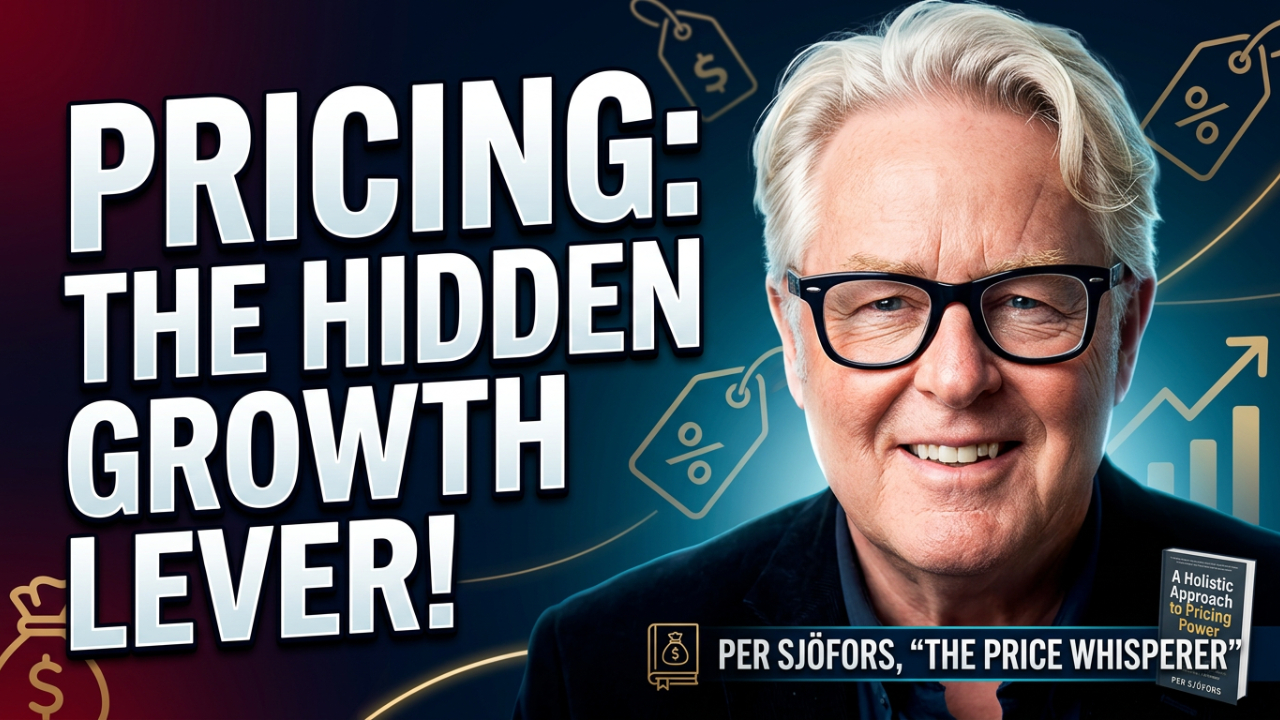
Per Sjofors is the founder and CEO of Sjofors & Partners, a pricing strategy consultancy, and the author of A Holistic Approach to Pricing Power. He is a member of the Forbes Business Council and has been named among Thinkers360’s Top 50 Global Thought Leaders. His work has been featured in Forbes, Fortune, Inc., Industry Week, Business Insider, and the Financial Times.

Learn more about Per’s work at sjofors.com, connect on LinkedIn at linkedin.com/in/persjofors or follow the company page at linkedin.com/company/sjofors, and find more of his content on YouTube at youtube.com/@thepricewhisperer.
Frequently Asked Questions
What is price anchoring?
Price anchoring is a pricing tactic where a business shows a customer a high reference price before a lower one, so the lower price looks more reasonable by comparison. The high price, often called the anchor, does not need to sell at all; its job is to shift how the rest of the pricing page or menu gets perceived.
Is price anchoring illegal?
Price anchoring itself is a legal and widely used pricing strategy, distinct from surveillance pricing, which uses private consumer data to charge different customers different prices for the same product and has been restricted in New York, with similar laws advancing in California and other states. Showing a high price alongside a lower one, as Apple did with its $17,000 gold Apple Watch, carries no legal issue on its own.
Why does price anchoring work?
Price anchoring works because of a cognitive shortcut researchers call the anchoring and adjustment heuristic, first documented by Amos Tversky and Daniel Kahneman, in which the first number a person encounters becomes the reference point for every judgment that follows. Individual buyers process this instinctively rather than analytically, so even an anchor price that was never meant to sell can reshape what a lower price feels like.
How can I use price anchoring in my own business?
Entrepreneurs can apply price anchoring by presenting their most expensive option first on a pricing page or menu, ordering choices from most to least expensive rather than the reverse, and making sure customers see the full value proposition before the price itself appears. Even a premium option that few customers select can still do its job by making every other price look more affordable by comparison.