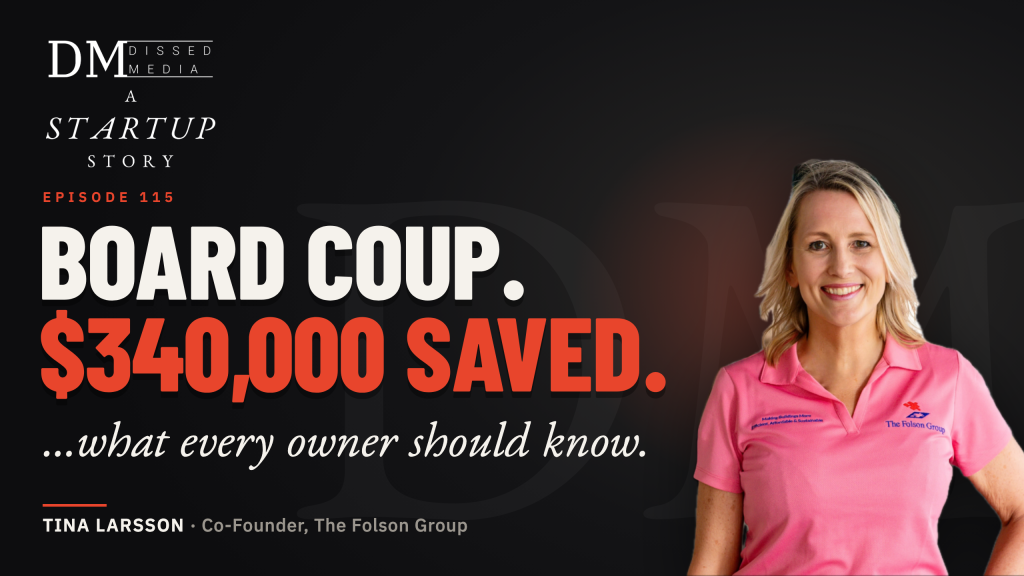

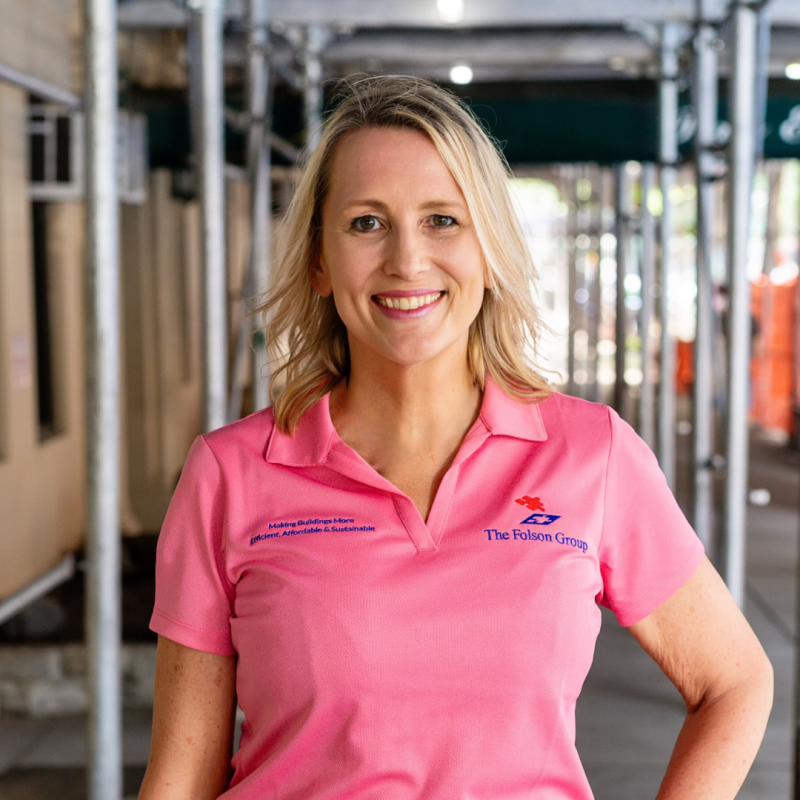
Most people who pay a monthly or annual fee to an HOA board or a co-op board tend to assume that someone on the other side of that payment is watching where the money goes, and in many communities owners only begin asking questions once something has visibly gone wrong. Tina Larsson started asking much earlier than that. As a Wall Street analyst living in a New York co-op, she noticed that her building’s fees had climbed by an average of roughly 5% a year for ten years in a row while the elevator and the boiler showed no sign of the upgrades those increases might have paid for; what she and her neighbors did about it eventually saved the building $340,000 and became the foundation of The Folson Group, a consultancy that helps co-op, condo, and HOA boards run their communities more like a business.
On this episode of DissedMedia: A Startup Story, host Ben Olmos and Larsson walked through the full arc of that story, from the board takeover she and her husband organized in their own building to the contingency model, project management work, and training platform that grew out of it. The conversation centers upon a simple idea that tends to get lost in community associations, which is that volunteer board members are making decisions about very large sums of other people’s money, often with little technical background and almost no data to compare against; however, Larsson believes that gap is exactly where a well-run board can create the most value for its owners.
How a Wall Street Analyst Found $340,000 in Co-op Overspending
Larsson and her husband both built their careers as analysts on Wall Street, with his work leaning toward macroeconomics and hers spanning general business analysis across a wide range of industries, so the steady fee increases at their co-op struck them as something that simply did not add up. About fifteen years ago, during a period when inflation was low, their building kept raising maintenance year after year while the major systems stayed the same age they had always been. When they began talking with neighbors, it became clear that many owners shared the same frustration, and the couple eventually turned that frustration into a plan to change who was making the decisions.
Once her husband became board president, he asked Larsson to apply her professional skill set to the building itself, which in her words was just another industry to learn, since she had spent her career analyzing stocks one day and energy companies the next. She went line by line through the building’s expenses and began comparing them against whatever outside data she could gather, and that comparison is what surfaced the outliers. The result was $340,000 in savings during the first three years, a figure that has since grown well past $2 million across the buildings The Folson Group serves, at which point Larsson says the team simply stopped counting.
Why an HOA Board Needs Benchmark Data Before It Signs a Contract
The core problem Larsson identified is one that almost every community association shares, regardless of whether it is a high-rise co-op in Manhattan or a neighborhood association with a pool. A building typically has one elevator service contract, one insurance policy, and one set of bids for any given project, which means the board has nothing meaningful to compare those numbers against. If an elevator service contract costs $2,000, a board without benchmark data has no reliable way of knowing whether that price is high, low, or perfectly reasonable, and so it tends to accept whatever the vendor or the property manager puts in front of it.
Building that benchmark became the foundation of Larsson’s approach. By gathering cost data across many buildings and using it to spot the line items that sat far outside the normal range, she could show a board where it was likely overpaying and then help it renegotiate from a position grounded in evidence. Business owners who have worked through operational audits will likely recognize the pattern, and it echoes the process discipline that Kati Peterman described when mapping business operations before trying to scale, since in both cases the savings tend to appear once someone finally looks at the whole system with fresh eyes.
Taking Over the Board to Get a Say
Larsson describes what happened in her building, with a laugh, as organizing a coup. Owners in a community association usually receive some financial information, though rarely all of it, and as an owner without a seat on the board you have very little say in how decisions get made. She compares it to complaining about government, where grumbling from the outside tends to accomplish little while running for office and winning gives you the ability to change things, and she notes that people generally do not respond well to criticism from neighbors who are not willing to take on the work themselves.
Their board had seven seats, and the group quickly realized that electing a single like-minded member would accomplish very little, since the remaining six could vote down every proposal. They needed a majority, so they recruited and elected four new board members who could vote together and actually move projects forward. For any owner who feels frustrated with the direction of their own community, Larsson’s experience suggests that the most effective path may be to run for the board and bring a few allies along, since a lone dissenting voice can be outvoted indefinitely.
Turning One Building’s Savings Into The Folson Group
Once they had three years of documented results, Larsson and her husband felt they had enough proof to build a company around the approach, and they launched The Folson Group in 2014. Their reasoning centered upon a gap in the market that becomes obvious once it is pointed out. A Fortune 500 company that wants to improve efficiency can call a large consulting firm to help it reallocate resources and eliminate processes that no longer serve it, yet the co-op, condo, and HOA world had no equivalent consultant focused specifically on how these communities operate.
By Larsson’s count, roughly 66 million Americans live in some form of community association, a sector that national organizations such as the Community Associations Institute track and support. The labels change by region, with HOAs common across much of the country, condos and community associations in Miami, and co-ops and condos dominating New York City, yet the structure is remarkably similar everywhere. Owners elect a handful of neighbors as volunteer board members who usually hold full-time jobs and have families and hobbies competing for their time, and those volunteers are then asked to make technical decisions about roofs, pools, boilers, and elevators on behalf of everyone else, often without the expertise to evaluate what they are being told.
The property manager is supposed to fill that gap, though in Larsson’s experience most managers carry heavy portfolios and simply do not have enough hours in the day to act quickly on every decision a board makes. That leaves a void between the volunteers who decide and the professionals who execute, and The Folson Group positions itself as the extra set of experienced eyes that sits inside that void.
The Contingency Model and a $504,000 Elevator Deal
Ben raised the obvious objection, which is that boards almost always say they have no money, so convincing them to hire a consultant would seem like a hard sell. Larsson agreed that budget is a hurdle, though she sees time as the larger one, and the firm addressed the money concern directly by building its cost reduction work on a contingency basis. A board pays nothing upfront, and The Folson Group earns its fee by splitting the savings it finds, which means a building with no reserves can still bring the firm in without first having to raise cash.
The example she shared makes the math concrete. An elevator consultant collected bids for one building’s elevator replacement, with the highest coming in at $1.5 million and the lowest at $750,000, and The Folson Group negotiated that same scope of work down to $504,000. The building would otherwise have needed to raise $750,000, and instead it needed to raise $504,000 plus the firm’s fee. Some boards still ask why they should share the savings at all, and Larsson’s private reaction, which she is careful never to say out loud, is that keeping 100% of no savings is always an option.
Project Management and Property Manager Searches
A couple of years after launch, a board approached the firm describing their co-op as having been run like a hippie community since the 1990s, with a long list of overdue projects and no bids to compare. With nothing to benchmark, there were no savings to split, so the firm took the work on a project management fee arrangement and delivered five projects within the timeline it had set. That engagement opened a second line of business focused upon complex work such as tracking down the source of leaks and installing heat pumps or electrification upgrades, along with repairing structural steel on the lower floors of tall buildings, the kind of projects that can drag on for years when nobody owns them.
A third service grew from the same insight. Because the firm works alongside property managers on behalf of boards, it sees firsthand how responsive and organized different management companies tend to be, and boards began asking for help replacing theirs. For a while the team declined in an effort to keep good relationships across the industry, until one board told them it was switching managers with or without their help. That engagement became a formal property management search service, with roughly 90 days of intensive work followed by a year of support, and Larsson notes that this service and project management tend to feel more urgent to boards than cost reduction, since a building that has lived under scaffolding for five years or has had leaks for a decade eventually reaches a breaking point. Founders who have handed off administrative work to free up their own time, as Adam Spector discussed when explaining back office outsourcing, may see a familiar logic in boards bringing in outside help to handle what volunteers cannot.
Florida, Surfside, and the Book Behind the Mission
The firm markets primarily to the Greater New York area, though it serves buildings elsewhere on the same terms and has worked with clients in Maryland and Chicago as well as Dallas. Florida is the next market Larsson is focused upon, partly because the state has a particularly high share of residents living in community associations and partly because of how dramatically the conversation there changed after the 2021 building collapse in Surfside, which led to new state requirements around inspections and reserves and left many owners facing large repair bills.
Surfside was also the moment that pushed Larsson to write her book, Living the High Life: How Smart Co-op and Condo Owners Protect Themselves and Their Investment. She points out that in New York City, by her estimate, around 80% of buildings were built before 1980, which means that any elevator, boiler, roof, or electrical system that has not been replaced is now close to 50 years old and well past its expected lifespan. Because volunteer boards tend to react to emergencies instead of planning ahead, she wanted a book that owners could pick up to understand why it matters to take an active role in their community, and that boards could use to move from a worst-case posture toward a proactive one, ideally completing at least one major project every year.

Where HOA Board Savings Most Often Hide
When Ben asked what boards most often miss, Larsson pointed out that a typical New York apartment building with a doorman and elevators carries roughly 150 separate cost line items, and savings can turn up almost anywhere among them. The most consistent opportunities, however, sit in heating, water, electricity, and insurance, along with major capital projects such as roof replacements, facade repairs, boiler replacements, and elevator modernizations, where the dollar amounts are large enough that even a modest improvement in pricing can change a building’s finances.
The firm has also worked with neighborhood-style associations outside of high-rise buildings, including one community repaving all of its roads and driveways and another planning a community-wide roof replacement. In those cases The Folson Group contributed mostly to the planning stage, which Larsson considers the most neglected part of any project. She believes many boards and property managers rush through planning, which is when timelines stretch and costs climb, so the firm encourages clients to stay in planning until the scope is clear and the funding is in place. Ben added that communities offering more shared services, such as retirement communities that handle landscaping and roofs, likely have more places to look for savings, and Larsson agreed, noting that people tend to scrutinize spending more closely when it comes out of their own pocket than when it is pooled with everyone else’s.
How the Folson Board Academy Trains New Board Members
The newest piece of the business is the Folson Board Academy, an education platform built around the reality that most board members are newly elected volunteers with no formal training. Larsson felt that much of the existing education in this space involved sitting through long, highly technical sessions that were difficult to absorb, so the team designed its core course as nine on-demand video modules that each run under five minutes, roughly 45 minutes from start to finish, with downloadable checklists and materials attached to every module.
The course covers HOA board responsibilities in practical terms, including what a newly elected member is accountable for and who they report to, along with how the roles of the board, the property manager, building staff, and outside vendors fit together. Larsson notes that while bylaws and state laws vary, the underlying dynamic is the same everywhere, so the content applies to associations across the country. It is priced at $99 and offered in packages covering either a single board member or a full board, with a separate version for property management firms that are tired of fielding beginner questions every time an annual meeting brings new members onto a board.
Shorter Meetings and Calmer Communities
Ben suggested that serving on a board can feel like a thankless job, since nearly everyone who reaches out does so because something is wrong. Larsson sees it differently, finding the work deeply fulfilling partly because the boards that hire her firm are, by definition, the ones that want to improve. She and her husband also bring an unusual perspective to the table, since they pay high monthly fees as owners in a building where he still sits on the board while also working daily alongside property managers, which gives them empathy for every group in the room when a fee increase or special assessment has to be announced.
Much of that empathy shows up as communication. The firm writes memos for boards and will offer its own phone number to the resident who always calls about the heat during a heating plant project, so that the property manager and the board are spared those calls. Her favorite example involves a board president whose monthly meetings regularly ran three hours and turned into shouting matches; she suggested moving them to Zoom, starting at 6:00, and announcing at the outset that he had another meeting at 7:00. He now calls her a few times a year to report that the meetings still finish quickly, and Larsson attributes the change to treating board members like the busy professionals they are in their day jobs, where meetings have end times and people tend to arrive having read the materials.
Owners and board members who want to learn more can find the book’s first chapter, a companion workbook, the newsletter that goes out on the first of every month, and details on every service at thefolsongroup.com.
Frequently Asked Questions About Running an HOA Board
What does an HOA board do?
An HOA board is a group of owners elected by their neighbors to make financial and operational decisions on behalf of the community, from approving budgets and fee increases to hiring vendors and overseeing major repairs. Board members are usually unpaid volunteers, and they typically rely on a property manager to carry out their decisions day to day.
How can an HOA board lower costs without cutting services?
According to Tina Larsson, the most reliable path is benchmarking: comparing each contract and expense against what similar buildings pay, then renegotiating the outliers. Heating, water, electricity, and insurance are the most common areas of overspending, followed by large capital projects where competitive bidding and careful planning can reduce costs significantly.
Is it hard to change HOA management companies?
Changing management companies can feel daunting for a volunteer board, which is why many boards wait until the situation feels urgent. The Folson Group runs property management searches on behalf of boards, with most of the work happening in the first 90 days and support continuing for a year after the transition.
What is the Folson Board Academy?
The Folson Board Academy is an online education platform from The Folson Group. Its core course is a $99, nine-module video program, about 45 minutes in total, that explains board responsibilities and how boards, property managers, staff, and vendors work together, with packages for individual members and full boards as well as property management firms.
Watch the Full Episode
Watch the full conversation with Tina Larsson on DissedMedia: A Startup Story below, and subscribe on YouTube to catch every new episode.