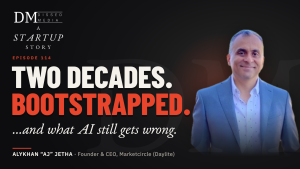
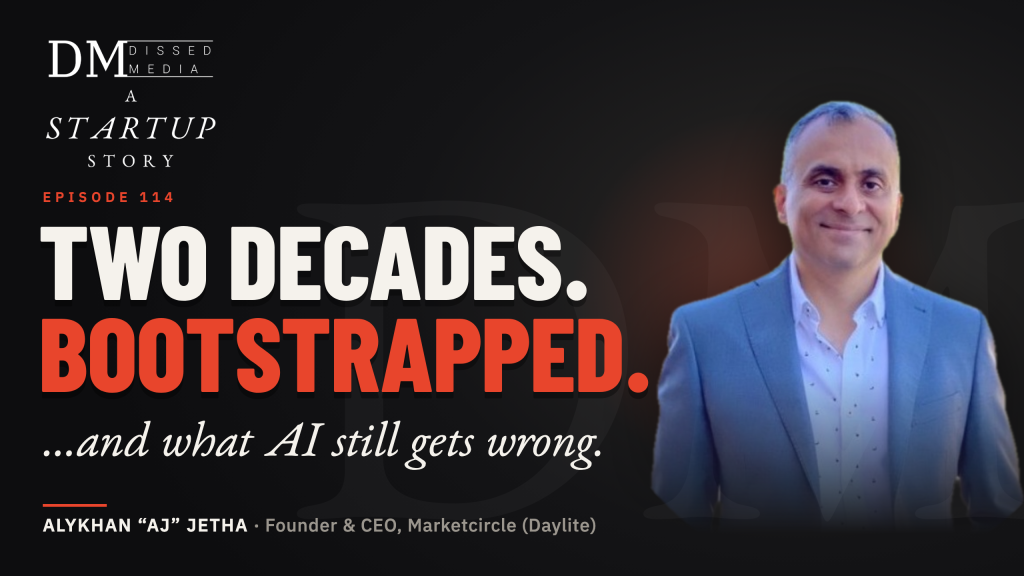

Anyone who has tried to hand a repeatable business process over to a large language model has likely run into the same wall sooner or later, where a tool that writes a brilliant first draft cannot be relied upon to produce the same answer twice. That is usually the moment when a conversation about LLM limitations becomes very practical. Alykhan Jetha, who goes by AJ and leads Marketcircle, the company behind the Mac CRM Daylite, hit that wall while trying to automate the way new customers configure his software for their industry; what he learned along the way has shaped how his team now thinks about where AI belongs in a product that customers pay for because it is dependable.
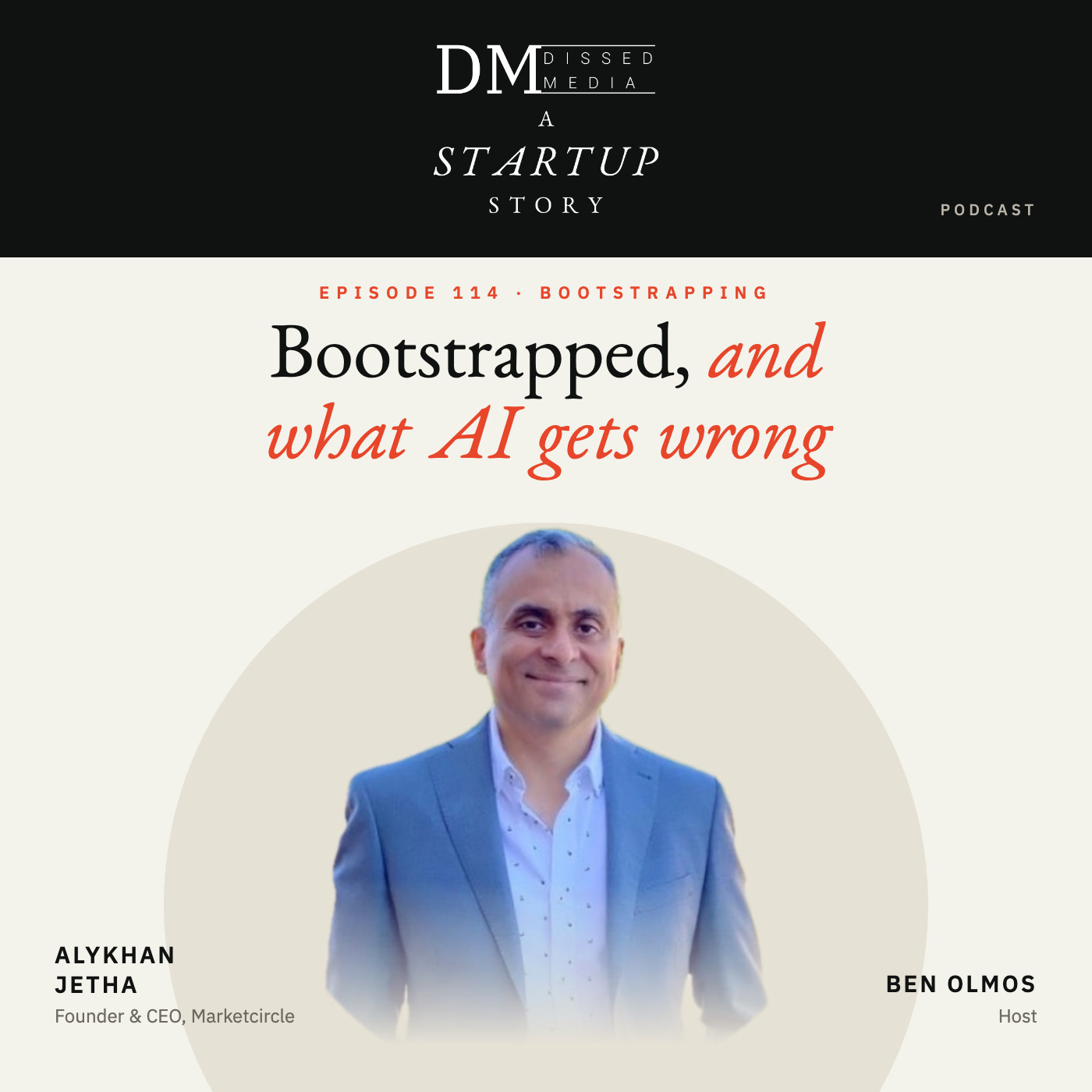
On episode 114 of DissedMedia: A Startup Story, host Ben Olmos and AJ covered a lot of ground. The conversation ran from building a customer-funded software company that serves consultants, real estate agents, lawyers, and designers to the frustration AJ feels when AI leaders talk about their products as though they were sentient. The thread running through all of it centers upon a founder who still writes code and who tends to build something with each new technology before forming an opinion about it, having designed his company around his own strengths.
How Daylite Grew From a Follow-Up Tool Into a CRM for Small Teams
Daylite began with a very personal problem that many consultants will recognize. AJ kept missing the follow-up calls he needed to make or, when he did remember them, could no longer recall the context of the last conversation. He wanted something that would keep him from looking unprepared in front of a client, and as he built it, his thinking widened toward a bigger question about how software might help a business grow. The answer he kept arriving at was that customers come first, since nothing else in a business can happen without them, and that delivering on whatever was promised to those customers comes immediately after; the CRM side of Daylite, in other words, emerged as a means to that larger goal, growing out of the follow-up tool he first built for himself.
AJ describes his ideal customer with a number that sounds odd at first, which is 1.5. A solo operator who simply wants to stay a solo operator is a one, while a 1.5 is an ambitious individual who already expects to hire an assistant or bring on production help, and who tends to grow into a team of two to ten people, often working remotely. Most of Daylite’s customers sit in that range. Some of the companies that started with fewer than ten people have since grown past 150 users, and a few grew large enough to be acquired and migrate into Salesforce, which AJ views as a natural consequence of Salesforce focusing upon the enterprise market.

The Productivity Pyramid and the Getting Things Done Influence
The foundation of Daylite is what AJ calls the productivity pyramid. In this structure, the bottom layer holds the work itself (tasks, meetings, time blocks, and reminders), the middle layer holds people in the form of contacts and companies along with the users on a team, and the top layer splits into opportunities on one side and projects on the other. In practice, opportunities are how a business wins deals, while projects are how it delivers on the promises made to close those deals, and because everything in the pyramid links together, a single task can carry the context of whether it serves a deal still being pursued or a commitment already made. That context, AJ argues, is often what allows a busy owner to actually execute instead of staring at an undifferentiated list.
When Ben brought up David Allen’s Getting Things Done, a book he credits with changing how he works, AJ noted that many of Daylite’s features are deliberately GTD-ish in nature. The work list is a good example; a business with many active projects can easily accumulate hundreds of open items, so Daylite lets a user choose the handful that matter today, reason about those during the day, and attach them to a time block so the commitment has a place on the calendar. AJ also recommended a second book for owners who want to understand waste, the short Swedish title This Is Lean, which he believes cuts through the jargon surrounding Lean and Six Sigma and gets to the core of how systems eliminate wasted effort.
That philosophy also explains a design choice that may surprise anyone who came up through heavy tools such as Microsoft Project. Ben recalled the years he spent managing projects at scale, when the software tracked everything beautifully while demanding constant upkeep. Project leads seemed to spend most of their time updating systems, an experience that will sound familiar to anyone who has read about what it takes to become a project manager. AJ intentionally calls Daylite’s approach project tracking, with a looser definition of a project that groups tasks and meetings without layers of dependencies, because an owner wearing ten hats will simply abandon any tool that asks for that much maintenance.
Why Daylite Stays Native on Apple Devices in the AI Era
With so much software moving into the browser, Ben asked why Daylite remains a native app in the Apple ecosystem, and AJ’s answer revealed that the app is only the visible layer of a much larger platform. Every user can keep an offline copy of their data on each Apple device they own, and a single company may have hundreds of devices synchronizing through a central server. That server in turn powers a REST API and Zapier integrations along with near real-time Google Calendar sync that usually lands a change in under a minute. Because the data lives locally as well as on the server, Daylite can take advantage of Apple’s on-device models and run a local MCP server, which lets a user connect assistants such as Claude or ChatGPT directly to their CRM data.
One workflow AJ described shows how this may play out in practice. A team member can take a meeting transcript from a note-taking tool such as Granola, pipe it through the local MCP server, and have Daylite create the resulting tasks, assign them to the right people, and record why each one was delegated; that data then syncs to everyone’s phone, where AJ’s team is working toward letting a user simply ask Siri what needs to happen today. AJ admits his reason for choosing Apple was also personal, since he finds Windows difficult to enjoy and believes his audience of owners whose business is their life tends to gravitate toward tools that keep IT headaches out of the way.
LLM Limitations AJ Discovered While Automating Industry Templates
Because Daylite is a horizontal product that serves many industries, one recurring challenge has been helping each customer configure it for their particular field, and the industry templates Marketcircle once built by hand took months of research to assemble. AJ decided to see what AI could do, so he created a skill loaded with Daylite knowledge in markdown documents and asked an assistant to produce a guide for real estate agents using Daylite; after chugging for ten or fifteen minutes, it returned a document of roughly 6,000 lines that he found genuinely impressive. Encouraged, he volunteered to build the next step himself, a tool that would turn guides like that one into database settings so a new customer could pick an industry at signup and start with a configured system.
That is where the LLM limitations became impossible to ignore. A database demands consistency, since fields cannot be invented on the fly, and no matter how many guardrails AJ wrote into his skill, he could not get the output to come back the same way twice. As he puts it, customers pay Marketcircle for reliability and availability, and a product that scrambles their data would quickly lose them, so understanding why one skill refused to behave consistently mattered far more to him than simply accepting it. His conclusion is that large language models are excellent at summarizing and extracting information, along with open-ended exploration; however, they lack consistent judgment by design, which means a process that depends on identical results should not let an LLM make the final determination.
Floating Point Math, Temperature, and the Case for Scripts
AJ’s explanation for the inconsistency draws on a lesson every financial software developer learns early, which is that currency calculations are never done in floating point because floating point does not guarantee the same result every time, whereas decimal arithmetic does. Language models are built on enormous matrices of floating point weights. Even when a developer turns down the temperature setting that controls variability, some degree of what people call hallucination tends to remain, partly because variation is what allows a model to sound conversational in the first place. Research published by Thinking Machines Lab on defeating nondeterminism in LLM inference suggests the causes may run even deeper than rounding, tracing much of the variability to how inference servers batch requests together, which seems only to reinforce AJ’s practical point about where these tools fit.
The approach AJ landed on is one that many owners may find useful when weighing LLM limitations against real business needs: use the model to write code or a script, and then let that script deliver the consistency, since a script behaves the same way every time it runs. Ben framed AI in similar terms, comparing it to the supplements and sports drinks a professional athlete uses, which can augment talent and training without substituting for either. The idea echoes a theme from an earlier conversation with Rob Broadhead about AI implementation challenges, where fixing a business process before automating it tends to separate the projects that succeed from those that stall.
AI Hype, Security Patches, and a Rebalancing Across Software
AJ was candid about how much the public conversation around AI frustrates him. He is especially bothered when executives at leading labs describe their models in ways that frighten people while preparing for enormous public offerings, and when stories about a model escaping containment later turn out to involve weak security practices that rarely make the headline. He compares the current moment to the invention of the database, which opened entire categories of solutions once people learned what belonged inside one and what did not, and he expects a similar wave of innovation as builders get more familiar with what LLMs are good at. Ben offered his own analogy, noting that computer displays once topped out at 256 colors before evolving into today’s 8K monitors, and suggested that AI may still be in its 256-color era.
One clear benefit is already showing up in AJ’s daily work. Marketcircle builds on Elixir, which runs on Erlang and the BEAM virtual machine. The Erlang Ecosystem Foundation has been using AI models with their safeguards removed to hunt for vulnerabilities in the platform and its popular frameworks, then using AI again to write patches. The result has been a steady stream of security advisories, known as CVEs, arriving at a furious pace over the last several months, some of which require breaking changes because an old assumption turned out to be unsafe. AJ jokes that he now has CVE PTSD; however, he views the trend as a net positive that is hardening systems across the industry, with the real risk falling on organizations that cannot or will not keep up with patching.
What Keeps a Bootstrapped Founder Building
When Ben asked what still gets him excited about going to work, AJ pointed first to the original vision for Daylite, which he feels he has yet to fully realize and believes AI may finally make more feasible. He has also designed the company around his own strengths and weaknesses. As a result, the list of things he must do that he dislikes stays short, while teammates who enjoy those tasks handle them, including the social videos that occasionally feature him. Above all, AJ simply likes making things; he still writes code, he says he would probably be building houses if he were not building software, and he admits that waking up with an idea and testing it through a few prompts can easily consume an entire day. For founders interested in how other bootstrappers think about cost and persistence, Ben’s reflection on what bootstrapping a media company actually costs offers a useful companion read.
AJ also pushed back gently when Ben suggested that the era of the MVP may be fading. In his view, founders still need to validate they are heading in the right direction, even if AI now lets them do it faster and include more in a first version than was once practical. To learn more about Daylite, visit daylite.app, and you can connect with Alykhan Jetha on LinkedIn, which he describes as the one social platform where he is reliably present.
Frequently Asked Questions About LLM Limitations
Why can’t LLMs produce consistent results?
Large language models generate text by predicting likely next words from huge matrices of floating point weights, and some variation is built into how they sample those predictions so that responses feel natural. Research also suggests that the way inference servers batch requests can change results from one run to the next, so the same prompt may return different outputs even under identical settings.
Does lowering the temperature make an LLM deterministic?
Lowering the temperature reduces variability and can cut down on hallucinations, although it typically leaves some inconsistency in place. In AJ Jetha’s experience building industry templates for Daylite, even heavily guarded prompts failed to return identical database settings across runs.
How should a small business use AI for repeatable processes?
A practical approach is to use an LLM to help write a script or piece of code, then run that script to do the repeatable work, since code produces the same output every time. LLMs tend to perform best at summarizing and extracting information, along with exploring ideas, which makes them strong partners for drafting and research while deterministic tools handle the steps that require precision.
What is Daylite and who is it for?
Daylite is a CRM and productivity app for Apple devices built by Marketcircle that combines contacts, sales opportunities, projects, tasks, calendars, and email in one place. It is designed for businesses that sell time and expertise, such as consultants, real estate agents, legal professionals, designers, and photographers, and it scales from ambitious solo operators to teams of more than 100 people.
Watch the Full Episode
Watch the full conversation with Alykhan Jetha on DissedMedia: A Startup Story below, and subscribe on YouTube to catch every new episode.