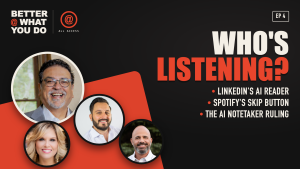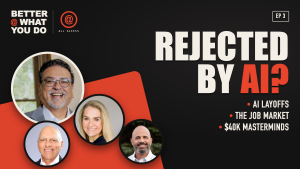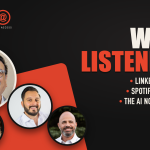
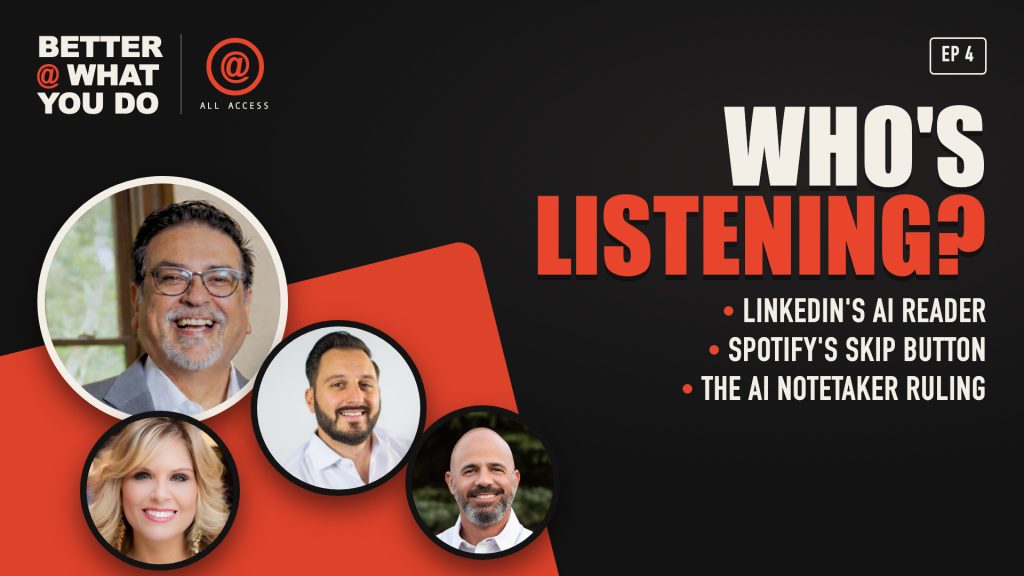

A LinkedIn content strategy that still earns reach in late 2026 rests on lived experience, a clear point of view, and real numbers, because the platform’s AI-driven feed is now built to bury the engagement bait that used to game it. That was the thread running through the fourth episode of Better at What You Do, where host Ben Olmos brought together three operators to unpack a week of changes reshaping how business messages reach buyers: LinkedIn’s rebuilt feed, Spotify’s new button for skipping sponsor reads, and a federal ruling that put AI note takers under legal scrutiny.
The panel included Jason Fishman, co-founder and CEO of Digital Niche Agency, Josh Rosenberg, founder of Forward Thinkers, and Lady Jen Du Plessis, founder of Kinetic Spark Consulting. Ben framed all three stories around one idea: there is now a third party in the room every time a business communicates, whether that is an algorithm reading a post before a buyer sees it, a skip button sitting in front of an ad, or a recording tool quietly capturing a meeting. If you are new to the show, the launch of Better at What You Do explains the panel format and why it brings returning DissedMedia guests together.
Why LinkedIn Rebuilt Its Feed Around Authenticity
Ben opened with the change most marketers have already felt. Earlier this year LinkedIn said it was rebuilding its feed around AI, with the goal of filtering out engagement bait: the “like, share, comment” prompts, the first-comment link tricks, and the formulaic posts written purely to please an algorithm. The tools reading those posts are now tuned for authenticity, which leaves a lot of creators wondering how to plan around rules they spent years learning.
Josh’s answer was that the fundamentals never changed. A post still needs a hook that meets a real problem in a short impression window, and it still needs to earn a connection through experience, expertise or validation. What changed is how quickly the feed punishes shortcuts. Josh said he experimented with AI-generated bait posts early on and watched performance drop, and he welcomed the cleanup because, in his words, too much of what circulates about AI and prompting is published without anyone fact-checking it.
A LinkedIn Content Strategy Built on Lived Experience
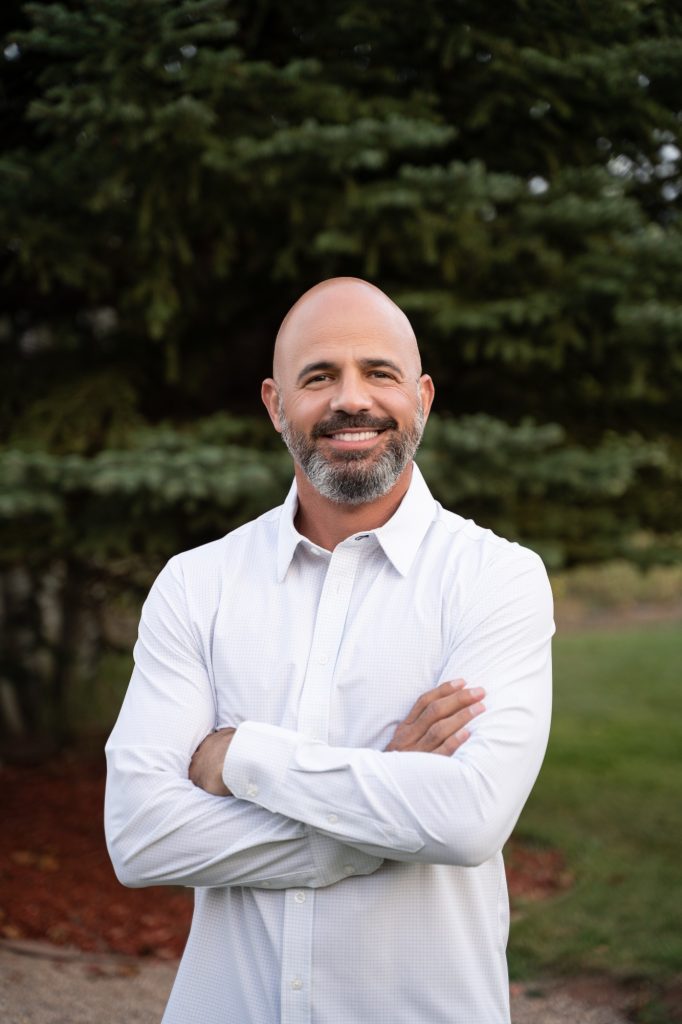
When Ben asked what actually resonates with a LinkedIn audience, Josh described a correction he made in real time. He had drifted into posting general AI commentary and noticed his audience pulling back. Engagement returned when he went back to writing from practical experience and tying each post to a problem his readers recognize. Over the four weeks before the recording, he said, posts about lessons learned from his own failures performed roughly ten times better than his other content.
His explanation was emotional connection. A reader under pressure wants to hear from someone who stood in the same spot, faced the same problem, and found a way through it. Josh also noticed that LinkedIn is converging with Meta’s platforms as a younger generation brings personal stories and opinions into a feed that used to keep them out, and those posts often perform well. Ben joked that photos of business lunches cannot be far behind, though he pointed out that the LinkedIn community still pushes back when content drifts too far from the platform’s purpose.
Lady Jen offered a simple reframe for anyone stuck on what to post. Swap “what should I post this week?” for “what did I learn this week, and what does my ideal client need to understand right now?” A perspective that challenges conventional thinking, backed by something you saw with a client or on a stage, gives readers a reason to stop scrolling. That approach lines up with what executive branding coach Debora Prossomariti told us about building CEO authority on LinkedIn, and it is the core of a LinkedIn content strategy that survives each algorithm update.
The Social Media Graveyard and the Case for Smaller Audiences
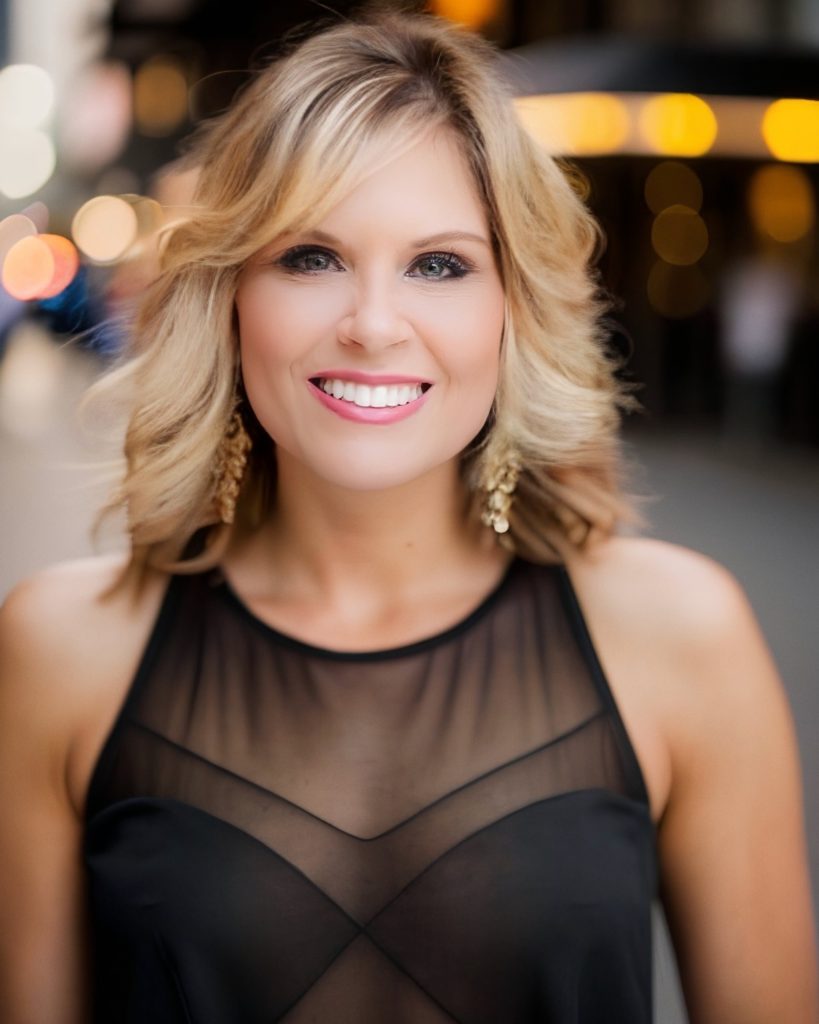
Lady Jen, who also goes by the Velvet Hammer, calls the current state of organic social the social media graveyard. She cited research recorded in 2024 showing organic reach had fallen about 98.5 percent across platforms over the prior seven years, so a creator with ten thousand followers may reach only a sliver of them. Add AI-written posts that friends can tell do not sound like the person behind them, and attention thins out even further.
That is why she is encouraged by LinkedIn’s direction. For years entrepreneurs were taught to chase followers, comments and algorithm hacks, and those numbers rarely turned into meaningful relationships or profitable businesses. Lady Jen has long argued that a smaller community of people who know and trust you, and who you understand how to serve, is worth more than thousands of people scrolling past. In her view the pendulum swung hard toward AI content and is now swinging back toward real relationships.
Gating a Lead Magnet or Giving It Away
Ben brought a question from his own experience. A podcast host once advised him to stop requiring an email address before readers could download the free first chapter of his book, arguing that the valuable people would reach out on their own. The panel split on it in a useful way.
Lady Jen holds two positions depending on the setting. When she is speaking to a defined audience, such as a room at a conference, she requires contact information, because far more people will take a free resource than will buy a product, and capturing them grows the database of people primed to purchase later. On a podcast, where the audience is harder to define, she gives the resource away and lets interested listeners come to her. Posting a free download on LinkedIn and hoping the right people grab it, she said, is closer to a spray and pray approach.
Jason leans toward openness with his thought leadership audience. He shares his methods freely through podcast episodes, webinars and conference talks, and he finds that serious prospects still ask his team to do the work. Seeing exactly how it is done builds confidence that the team knows what it is doing. For his clients’ investor campaigns, the approach is the opposite of passive: his team mines data on people who have actually invested in live offerings, matches them to contact details, and tests audiences across campaigns.
Why LinkedIn Messaging Outperforms the Feed for Outreach

Ben pressed Jason on his audience in particular. Investors tend to care about return more than about a founder’s hardship story, so what works for them? Jason said the biggest LinkedIn wins he sees happen inside the messaging inbox. He spends a few minutes in the news feed but most of his LinkedIn time responding to and sending direct messages, and many of his clients hire Digital Niche Agency specifically to reach investors that way.
He was candid about LinkedIn ads. Costs can run higher, click-through rates lower, and conversion weaker depending on the ask, so he often favors other ad channels for his campaigns. LinkedIn’s data, however, is hard to match. A Sales Navigator search will surface a surprising number of people who list investor in their job title, filtered by city and industry, and Jason said his team looks for around a 20 percent invitation acceptance rate and a 20 percent response rate from those campaigns. The goal of each conversation is a call, and a free resource or clear early value helps get there.
His other rule for a LinkedIn content strategy aimed at investors and B2B buyers is to lead with numbers. Industry analysis, case studies and growth figures are what bring a story to life for that audience. Investors want the numbers, and prospective clients want case studies with results attached. Jason walked through more of his investor marketing playbook when he joined us for how he raises millions for startups online, and Daniel Alfon’s take on networking on LinkedIn without cold pitching pairs well with it.
What Sponsors Actually Buy When Listeners Can Skip the Ad
The second story hit close to home for a panel full of podcasters. Spotify has added a skip-ahead button that appears in front of sponsor reads, and YouTube offers similar controls when it detects a promotion. Listeners love skipping ads, but shows that depend on sponsorship need those reads heard. Ben asked what a sponsor is really paying for.
Lady Jen stepped away from defending advertising and shared her own experience instead. Rocket Mortgage once sponsored her long-running mortgage podcast for six to eight months, and despite strong weekly downloads, neither side saw meaningful results. She has made her money through relationships, and she pointed to a friend whose show draws about a hundred downloads a week yet supports a seven-figure business. In her model the episode is where the relationship begins, which is the same approach she laid out when she explained how to monetize a podcast through guest conversations.
Jason took the advertising side. Sponsors buy impressions, measured as listens or views, and they compare that media value against other channels. Some podcast networks now sell host-read ads on a cost-per-click basis, with a tracking pixel in the advertiser’s funnel, so a sponsorship can be managed as a direct response channel. He has seen strong return on ad spend from these placements, and more audiences converting from host-read ads than before. He also sees value beyond clicks: a founder who appears on a new podcast every week looks stronger to investors and partners than one who does not.
Josh tied it back to audience fit. His agency both advertises and books podcast appearances, and he said most wasted spend comes from placing an ad in front of the wrong audience. If listeners skip, the cause may be a sponsor that never matched the show’s demographic in the first place.
The Otter AI Lawsuit and the Third Party in the Room
The final story gave the episode its name. Ben uses Granola, an AI note taker that runs in the background and feeds meeting context into his AI tools, and he loves how much it helps him plan. But Otter AI is facing a consolidated class action, and on August 13 a federal judge in the Northern District of California let the core wiretapping and privacy claims move forward. As UC Today reported on the Otter AI ruling, Judge Eumi K. Lee granted part of Otter’s motion to dismiss while allowing claims under federal wiretap law, California privacy law and Illinois biometric privacy law to proceed. The ruling allows the case to continue; it does not find that Otter broke the law.
Consent rules vary by state. Ben lives in Georgia, a one-party consent state, where only one person in a conversation needs to know it is being recorded. California requires everyone on the call to consent. For background note takers that capture context from every participant, that patchwork creates real exposure.
Consent, Governance and the Rule of Assuming You Are Recorded
Every panelist uses AI note takers, and every panelist argued for disclosure. Josh said his team runs them on every call, but he does not believe they should ever operate in the background without people knowing, regardless of state law. A careless comment captured on a recording can end up in legal discovery, and a misstatement that leaks becomes part of your name and likeness. He also shared how much value they create when used openly: his notes feed an AI agent that plans his next day, and a recording once helped him clarify a client’s shifting position privately before redirecting his team.
Josh added a sobering example. He recently finished a six-year public company dispute that he said involved recorded calls manipulated by bad actors, and once that material was placed, it was very hard to call back. Jason agreed that secret recording is simply bad etiquette. Early in his agency’s life, his general counsel trained him to assume anything he said could appear on the front page of The New York Times, out of context. With permission on both sides, he said, a 30-minute recording with a CEO can become a month of content.
Lady Jen framed it as a relationship question. Her concern is whether everyone in the meeting understands what happens to their information. She lives in Virginia, another one-party state, yet she asks permission at the start of every call, offers to share the transcript, and lets that verbal consent live in the recording itself. She also reminded the panel that AI transcription gets things wrong, recalling a summary that claimed she charges $30 million for coaching. Her 30/40/30 rule applies: 30 percent a strong prompt, 40 percent letting the tool work, and 30 percent human judgment to test and audit the output.
Frequently Asked Questions
What is the best LinkedIn content strategy after the algorithm update?
The panel’s advice is to write from lived experience, tie each post to a problem your ideal client recognizes, and share a clear point of view. Lessons from failure and specific, numbers-backed examples performed best for these operators, while engagement bait and generic AI-written posts lost reach.
Is LinkedIn messaging better than posting for B2B lead generation?
For Jason Fishman’s investor and B2B campaigns, direct messages produce the most results. He uses Sales Navigator to find targeted prospects and aims for around a 20 percent invitation acceptance rate and a 20 percent response rate, with the goal of booking a call.
Are AI note takers legal to use in meetings?
It depends on where the participants are. One-party consent states such as Georgia and Virginia allow recording when one participant knows, while states such as California require everyone’s consent. The panel recommends announcing any note taker and getting verbal permission from everyone, whatever the local law requires. This is general information, so check with a lawyer about your situation.
What happened in the Otter AI lawsuit?
On August 13, 2026, a federal judge in the Northern District of California partly denied Otter’s motion to dismiss a consolidated privacy class action, allowing wiretapping, California privacy and Illinois biometric claims to proceed. The case is ongoing, and no court has found that Otter violated the law.
Do podcast ads still work if listeners can skip them?
Jason Fishman reports growing conversions from host-read ads, especially when they are tracked with a pixel as a direct response channel. Josh Rosenberg and Lady Jen Du Plessis stressed audience fit and relationships, noting that a sponsor matched to the right listeners loses less to the skip button.
Watch the Full Better at What You Do Panel
Hear Jason Fishman, Josh Rosenberg and Lady Jen Du Plessis work through LinkedIn content strategy, podcast advertising and AI note takers in the full episode below.